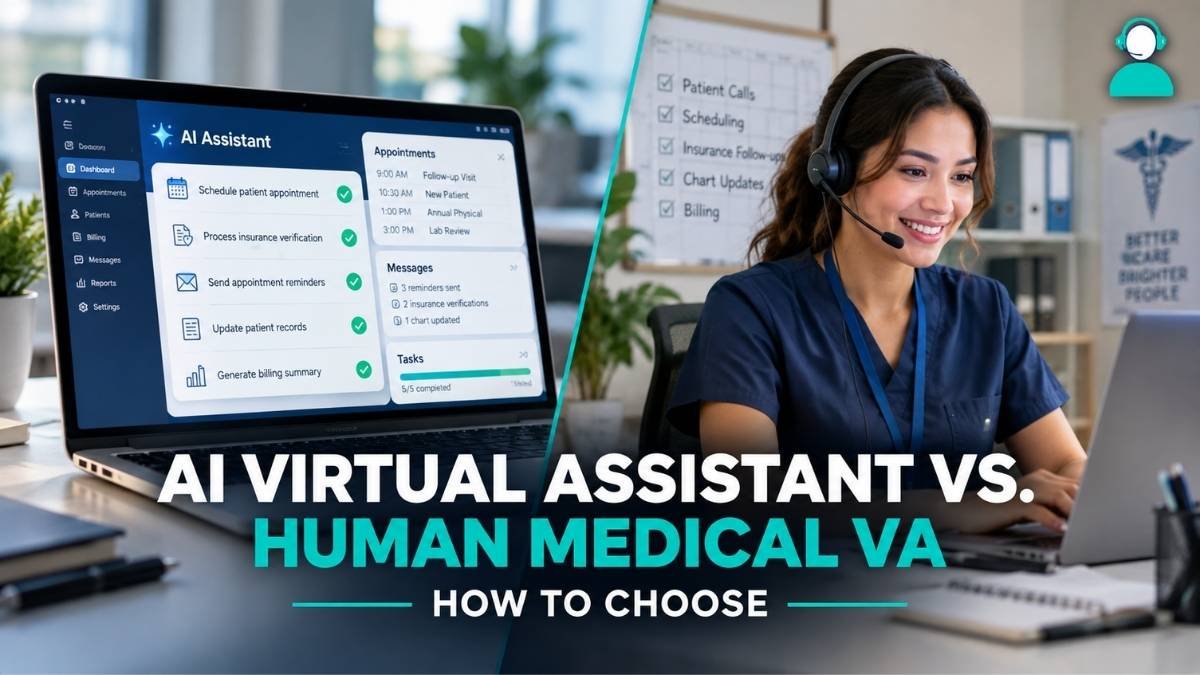

Internal medicine practices manage a high volume of patient encounters, each generating paperwork that competes with time available for direct care. A single day’s schedule can include a dozen or more visits, each followed by documentation, billing, and follow-up work.
Physician burnout dropped to 41.9% in 2025, yet administrative burden remains a leading driver of physician stress, according to American Medical Association data.
Practice managers increasingly ask which tasks can be handed off without compromising patient safety or compliance. Virtual assistant tasks for internal medicine doctors typically fall into scheduling, documentation support, billing coordination, and follow-up communication.
This article outlines what these tasks look like in practice, where clinical boundaries apply, and how delegation affects daily operations.
What Virtual Assistant Tasks Look Like In Internal Medicine

Internal medicine practices delegate a defined set of administrative and support tasks to virtual medical assistants. Each task carries different requirements for training, system access, and oversight, described below by category.
1. Patient Scheduling and Calendar Management
Scheduling is one of the most common virtual assistant tasks for internal medicine doctors. They manage appointment booking, cancellations, and waitlists through the practice’s scheduling system.
They coordinate provider calendars across multiple locations or telemedicine slots. Accurate scheduling reduces gaps in the day and limits overbooking. Most practices connect this task to their patient portal, allowing patients to confirm or reschedule visits directly.
Scheduling accuracy also affects billing, since incorrect visit types can lead to coding errors downstream.
2. Clinical Documentation Support
Clinical documentation support involves preparing charts before visits and formatting physician notes afterward. Healthcare virtual assistants organize patient history and referral letters ahead of each appointment.
Some visits rely on medical transcription for dictated notes, which virtual assistants then format within the record using the electronic health records (EHR) system. This work does not include interpreting clinical findings.
Physicians review and finalize all documentation before it becomes part of the permanent record.
3. Medical Billing and Coding Assistance
Medical billing and coding assistance covers claims preparation, code verification, and communication with billing supervisors.
Virtual assistants check that documentation supports the codes submitted, flagging mismatches before claims go out. In most states, final coding authority remains with certified coders.
Virtual assistant support reduces manual data entry, a common source of claim denials. MGMA data shows a first-submission claim denial rate of about 8% across single-specialty medical practices, making early accuracy checks worthwhile.
4. Insurance Pre-Authorization Handling
Insurance pre-authorization handling includes submitting requests, tracking payer response times, and gathering supporting documentation.
A virtual medical assistant monitors authorization status and follow up with payers before appointments are affected. This task reduces delays that otherwise fall on front-desk staff
during check-in. Pre-authorization work requires attention to payer-specific rules, which vary by insurer and procedure. Errors in this process can delay treatment or result in denied claims.
5. Patient Follow-Up and Care Coordination
Patient follow-up and care coordination includes appointment reminders, post-visit check-ins, and referral tracking.
Virtual assistants confirm that referrals were scheduled and test results were received. They send reminders for recurring visits, such as chronic disease management appointments common in internal medicine.
This task differs from clinical triage, which requires licensed judgment about symptoms or urgency. Consistent follow-up reduces missed appointments, which affects patient outcomes and practice revenue.
6. EHR Data Entry and Chart Maintenance
EHR data entry and chart maintenance covers structured data entry, record updates, and cleanup of duplicate records.
Virtual assistants enter demographic updates, insurance changes, and visit notes into the EHR system, flagging incomplete fields for physician review. Clean, current records reduce billing errors and support accurate reporting.
This task requires role-based system access limited to data entry functions. Physicians retain authority over diagnostic and treatment entries within the record.
Also Read: How Virtual Assistants Improve Medical Record Accuracy?
7. Telemedicine Coordination Support
Telemedicine coordination support includes scheduling virtual visits, confirming technical setup, and sending pre-visit intake forms.
Virtual assistants verify that patients have working video access before appointment time, and collect insurance and consent information required for billing. This task reduces the number of visits lost to technical issues.
Telemedicine volume has grown steadily across internal medicine practices, making coordination a recurring administrative need. Virtual assistant support here focuses on logistics, not clinical evaluation.
Tasks That Should Remain In-House
Some tasks should remain with licensed staff regardless of administrative capacity. Diagnosis, prescribing, and clinical triage require a provider’s direct judgment and cannot be delegated. Interpreting lab results or advising patients on symptoms falls outside virtual assistant scope.
Practices that blur this boundary create clinical risk and liability exposure. Clear, written task definitions help staff and virtual assistants understand where delegation ends. Review this boundary whenever software or workflow changes are introduced.
| Compliance Tip |
|---|
| A virtual assistant handling patient information without a signed Business Associate Agreement creates HIPAA exposure for the practice, not just the vendor. |
How Virtual Assistant Tasks Fit Into Daily Practice Workflow

Tasks assigned to a virtual assistant move through defined handoff points between front desk, physician, and support staff. Understanding these handoffs helps identify where delays or errors typically occur.
Most practices route virtual assistant tasks in internal medicine through practice management software, which tracks task assignment and completion.
A scheduling request moves from patient contact to virtual assistant to calendar confirmation, with front-desk staff verifying accuracy. Billing tasks follow a similar path, moving from documentation to coding support to supervisor review.
Workflow friction usually appears at handoff points rather than within individual tasks.
AMA President Bobby Mukkamala, MD, has noted that building effective, lasting solutions requires better understanding where physicians are struggling and why. Mapping each handoff point serves a similar purpose at the practice level.
HIPAA Compliance And Data Security Considerations
Any virtual assistant task involving patient information falls under HIPAA compliance requirements. This section covers access controls, agreements, and monitoring practices that apply to remote support staff.
Virtual assistants who access protected health information must operate under a signed Business Associate Agreement.
Regulators expect business associates to implement and document role-based access controls and conduct periodic access reviews. Permissions should match the specific task assigned, not general system access.
Clean access design is an operational safeguard, not just a legal formality. Compliance reviews should happen at least annually, alongside any change in task scope.
| Compliance Tip |
|---|
| Limit virtual assistant EHR access to the specific fields required for their assigned tasks. Broad access increases audit risk without adding operational value. |
Virtual Assistants Compared With In-House Administrative Staff
Comparing virtual medical assistants vs. in-house staff and choosing between them depends on task volume, budget, and required system access. The comparison below outlines the operational differences.
Virtual assistant staffing typically starts faster than a new hire, since it avoids recruiting and credentialing timelines.
In-house staff may take on broader clinical-adjacent duties, depending on licensure and role definition. Space and equipment costs apply to in-house hires but not to remote support.
Both staffing models require compliance oversight, though the specific requirements differ.
| Factor | Virtual Medical Assistant | Additional In-House Hire |
| Onboarding timeline | Typically faster | Longer (recruiting, credentialing) |
| Task scope | Administrative and documentation support | Administrative, sometimes broader |
| Space and equipment cost | None | Desk, hardware, EHR seat license |
| Coverage flexibility | Scalable by task volume | Fixed to employment terms |
| Compliance oversight needed | Yes, BAA and access controls | Yes, standard HR and compliance |
| Direct patient-facing clinical duties | Not applicable | Possible, depending on role |
Frequently Asked Questions (FAQs)
What tasks can a virtual assistant not perform in an internal medicine practice?
Virtual assistants cannot diagnose, prescribe, or interpret clinical findings. These tasks require a licensed provider’s direct judgment. Delegation should stop at data entry, scheduling, and administrative coordination.
Do virtual medical assistants need HIPAA training?
Yes. Any virtual assistant handling protected health information needs HIPAA training and a signed Business Associate Agreement. Training should cover minimum necessary access and reporting requirements.
How does a virtual assistant access a practice’s EHR system securely?
Access is typically granted through role-based permissions limited to assigned tasks. Practices should review these permissions periodically, especially after role changes or software updates.
Can a virtual assistant handle insurance pre-authorization independently?
Virtual assistants can submit and track pre-authorization requests, but approval decisions rest with the payer. Complex clinical justification for authorization typically requires physician input.
How is virtual assistant work verified for accuracy in billing tasks?
Most practices route billing tasks through a second reviewer, such as a coding supervisor, before submission. This step reduces denial risk tied to manual entry errors.
Final Thoughts – Virtual Assistants For Internal Medicine
Virtual assistant tasks for internal medicine doctors center on administrative and documentation support: scheduling, billing coordination, EHR maintenance, and follow-up communication.
Clinical judgment remains with licensed staff in every case. Delegation works best with clear task boundaries, defined system access, and a verification step for billing and documentation accuracy.
Practices considering this staffing model should map current administrative bottlenecks before assigning tasks, not after. That sequence determines whether delegation reduces workload or simply relocates it.
References
- Sara Berg (2026). These 9 physician specialties report highest burnout rates. American Medical Association
- Summary of the HIPAA Security Rule
https://www.hhs.gov/hipaa/for-professionals/security/laws-regulations/index.html
- Chris Harrop (2024). Strategic improvements in your RCM to reduce your practice’s claim denials. MGMA Stat
- Cailey Gleeson (2026). Physician burnout falls for third year in 2025 to 42%, AMA data shows