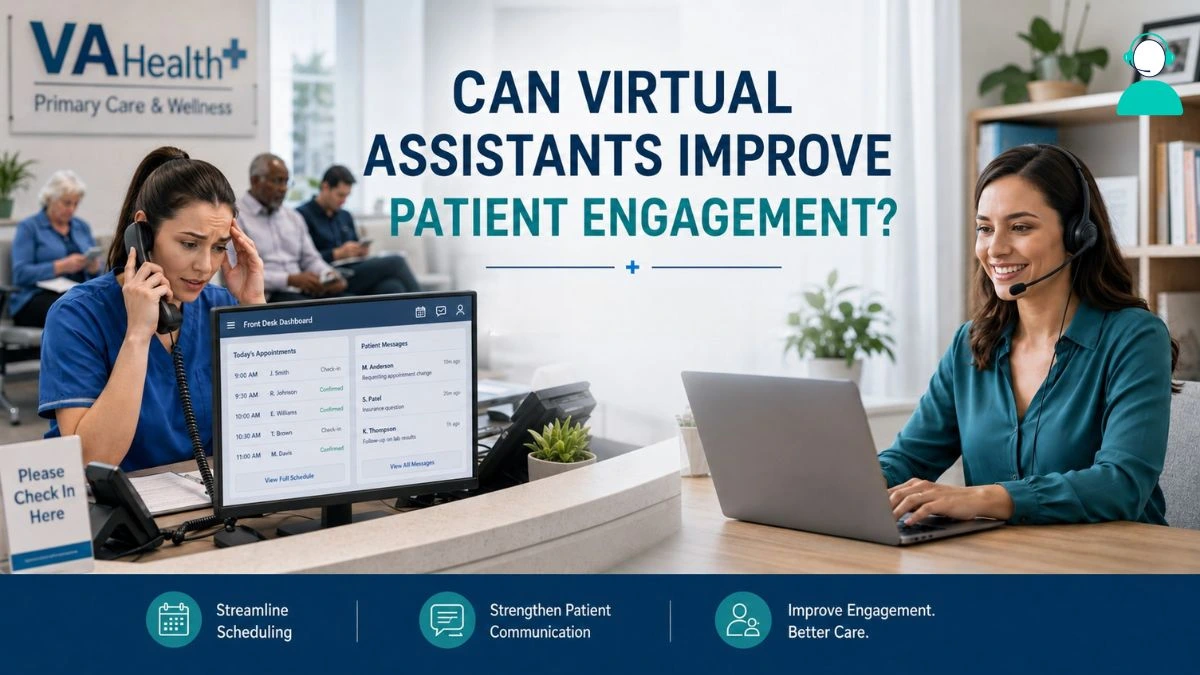
Front-desk staff at most clinics split their day between phone calls, portal messages, and reminder follow-ups.
When one person is out sick, engagement tasks stack up fast. That operational reality is why clinic owners keep asking how virtual assistants improve patient engagement without adding another full-time hire.
This article breaks down where a medical virtual assistant fits into daily workflows, which tasks are safe to delegate, and what compliance steps need to be in place first.
The goal is operational clarity, not a sales pitch for any particular tool.
What Patient Engagement Actually Means In A Clinic Setting
Patient engagement gets used loosely, so it helps to define it in operational terms before assigning any task to outside support.
Patient engagement refers to the specific actions a clinic takes to keep patients informed, scheduled, and following through on care plans. It includes reminder calls, portal messages, appointment confirmations, and education follow-ups. It does not include the clinical decisions behind a treatment plan.
This distinction matters for staffing. A clinic can delegate the communication and follow-through around a treatment plan without touching the plan’s clinical content.
According to Gitnux, patient portal users have been associated with fewer hospital readmissions, while higher patient engagement is also linked to improved health outcomes.
That outcome data is one reason staffing decisions around engagement tasks carry real weight. The operational question for practice owners is narrower: which tasks consume staff time, and which of those require a license to perform?
Here’s How Virtual Assistants Improve Patient Engagement

A healthcare virtual assistant typically takes over administrative and communication tasks that surround a patient’s care, not the care itself. The eight areas below cover where this support most commonly applies, along with the risk boundary attached to each one.
1. Appointment Scheduling and Reminder Workflows
Scheduling is usually the highest-volume task in any clinic, and it is also the easiest to delegate. A virtual medical assistant can confirm appointments, manage rescheduling requests, and follow up on no-shows by phone or text.
This work does not require clinical training, only clear scheduling rules and calendar access.
No-show follow-up deserves attention here. A short call within 24 hours of a missed appointment recovers a meaningful share of bookings that would otherwise stay open, keeping front-desk staff available for in-person patients instead.
2. Medication Reminder and Adherence Support
Medication reminders sent by a virtual medical assistant are administrative: a scheduled text or call confirming a refill date or dosage time.
Adherence support stays non-clinical as long as the assistant relays information already approved by the prescriber, not questions about side effects or dosage changes.
The task itself is simple, but the boundary is not. Any question that requires clinical interpretation should route back to a licensed staff member immediately, with the interaction logged for the record.
3. Patient Portal Management and Message Triage
Portal inboxes fill up quickly, and most messages fall into a handful of categories: scheduling requests, billing questions, refill requests, and clinical questions.
A virtual assistant can sort these by category and route clinical questions to the right provider without reading into their content.
This triage work reduces the time clinical staff spend scanning irrelevant messages. It requires a clear intake protocol defined in advance, so the assistant knows exactly which message types to escalate.
Vague routing rules are the most common cause of triage errors here.
4. Telehealth Coordination and Pre-Visit Preparation
Telehealth visits depend on preparation that has nothing to do with the clinical encounter itself: scheduling the link, confirming working audio and video, and making sure intake forms are complete beforehand. A virtual medical assistant can own this entire pre-visit sequence.
More than 80% of healthcare providers report that patients have better access to care since using telehealth, according to American Medical Association (AMA).
A patient who cannot connect on time loses appointment time a clinician cannot recover later.
5. Symptom Checker Support and Triage Documentation
A symptom checker tool collects patient-reported information before a visit or call. A virtual assistant can help a patient complete that intake form and log the responses, but interpreting those results is a clinical function, not an administrative one.
The distinction is about output, not effort. Sending a reminder to complete a symptom checker is administrative. Deciding what the completed responses mean for care is not.
Clinics should document this boundary in writing so no assistant assumes interpretive responsibility by default.
6. Remote Patient Monitoring Data Follow-Up
Remote patient monitoring devices generate a steady stream of data: blood pressure readings, glucose logs, weight trends. A virtual assistant can track whether patients are submitting readings consistently and flag missing data to the care team.
What the assistant should not do is decide whether a specific reading warrants clinical concern. That judgment belongs to a nurse or physician reviewing the trend, not the assistant tracking completeness.
7. Health Literacy and Patient Education Support
Health literacy gaps are a known driver of missed appointments and poor follow-through. Only 23% of patients report feeling fully informed about their treatment options, based on current patient engagement research.
A virtual assistant can help close part of that gap by sending pre-approved educational materials after a visit. This works only when materials are approved in advance by clinical staff, with no room for the assistant to summarize medical content independently.
The assistant’s job is distribution and follow-up, confirming the patient received the material, not authorship.
Risk Boundaries: What Virtual Assistants Should Not Handle
Every task above has a companion boundary. Virtual medical assistants should not diagnose symptoms, interpret test results, adjust medications, or make triage decisions about urgency. These require a license and carry liability that sits with the clinical team.
Compliance: A virtual assistant can send a reminder about a symptom checker. A licensed clinician must interpret the results. Documenting this boundary in a written scope-of-work agreement protects the clinic and the patient equally.
For more details on what a VA should handle, read our guide on tasks a medical virtual assistant can do.
Which Patient Engagement Tasks Can Be Delegated Safely
Deciding what to delegate comes down to one test: does the task require interpreting clinical information, or relaying and organizing information a clinician already produced?
Safe to delegate to a virtual assistant:
- Appointment confirmations, rescheduling, and no-show follow-up
- Medication refill reminders based on existing prescriptions
- Portal message sorting and non-clinical response drafting
- Pre-visit form collection and telehealth technical setup
- Distribution of provider-approved educational materials
Requires licensed clinical staff:
- Any interpretation of symptoms, lab results, or monitoring data
- Medication changes, dosage questions, or side-effect guidance
- Triage decisions about the urgency of a patient’s condition
Common Mistake: Clinics sometimes assume that any patient-facing communication is automatically administrative. Message content, not the communication channel, determines whether a task is clinical.
Virtual Assistant Vs In-House Staff For Patient Engagement
Comparing a virtual assistant with an in-house hire is a staffing capacity question first, and a cost question second.
| Factor | Virtual Assistant | In-House Assistant |
|---|---|---|
| Onboarding time | Days to weeks | Weeks to months |
| Coverage hours | Flexible, can extend beyond shift hours | Limited to scheduled shift |
| Cost structure | Hourly or task-based | Salary plus benefits |
| Scalability | Adjusts with patient volume | Fixed capacity per hire |
| Compliance oversight needed | Yes, defined in contract | Yes, defined in internal policy |
Neither option eliminates the need for oversight. A virtual medical assistant reduces fixed staffing costs and adds scheduling flexibility, but still requires a defined scope of work and monitoring.
Healthcare operations advisors generally note that shifting clerical tasks to outside support lets clinical staff spend more time on direct patient care.
Also Read: Advantages of Virtual Medical Assistant In Healthcare
Compliance And Risk Considerations When Delegating Patient Engagement
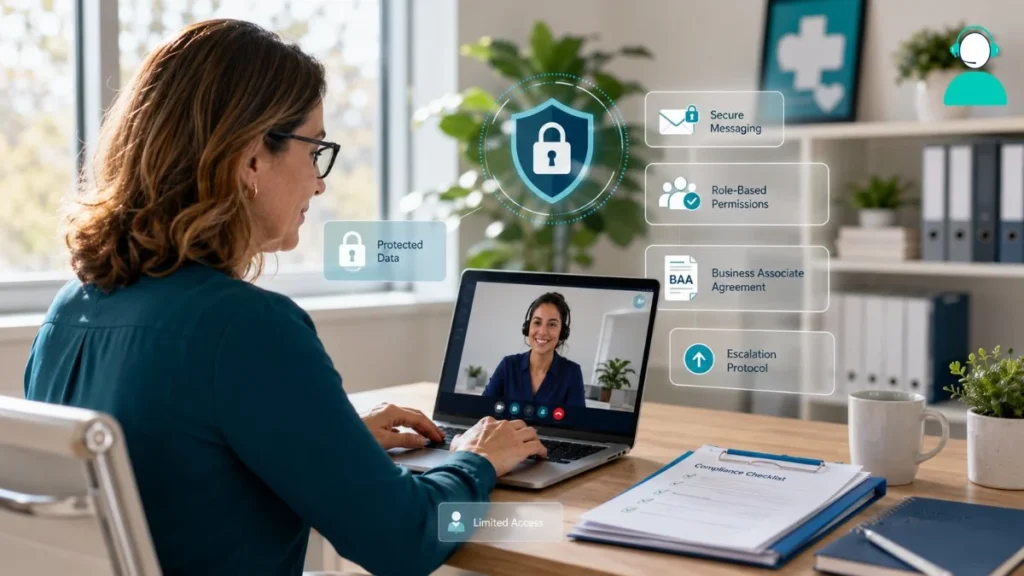
Any engagement task that touches patient data brings HIPAA compliance into the conversation, regardless of whether the person handling it is an employee or a contracted assistant.
A virtual assistant who creates, receives, or transmits protected health information on a clinic’s behalf generally qualifies as a business associate under HIPAA.
HHS guidance requires a signed business associate agreement between the covered entity and that vendor before any protected health information changes hands. Compliance officers widely treat this as a baseline requirement, not an optional safeguard.
A signed agreement is only the starting point. Clinics also need secure messaging platforms, defined access controls limiting what the assistant can view, and a documented escalation path for anything outside its scope.
Skipping any one step creates the same liability exposure as skipping all three.
| HIPAA Tip A business associate agreement must be in place before a virtual assistant accesses scheduling systems, portal messages, or any record containing patient health information, not after. |
Implementation – What Clinics Should Set Up Before Delegating
A short setup process prevents most problems clinics run into later. Four items belong on this checklist before any patient-facing task moves to a virtual assistant.
First, define task boundaries in writing, listing which activities the assistant handles and which route to clinical staff. Second, set an escalation protocol so ambiguous requests default to a licensed team member rather than a guess.
Third, confirm the communication platform is secure and covered under a signed business associate agreement. Fourth, schedule a documentation review after 30 days to confirm the boundaries are holding up in practice.
Clinics that skip the review step often find boundary drift only after a complaint forces a closer look. Building the review into the rollout avoids that gap.
Frequently Asked Questions (FAQs)
What tasks can a healthcare assistant handle without clinical oversight?
Scheduling, reminder calls, portal message sorting, and distribution of pre-approved educational materials generally require no clinical oversight, provided the scope is documented in advance.
Is it HIPAA compliant to use a virtual assistant for patient communication?
It can be, provided a signed business associate agreement is in place, the communication platform is secure, and data access is limited to what the role requires.
How does a virtual medical assistant differ from a virtual scribe?
A virtual medical assistant typically manages scheduling and administrative communication, while a virtual scribe documents clinical encounters in real time under a provider’s direction.
Can virtual assistants access a patient portal directly?
Yes, with defined access permissions and a business associate agreement in place, an assistant can respond to non-clinical portal messages and route clinical ones to staff.
Final Thoughts
Virtual assistants extend administrative capacity around scheduling, reminders, and portal triage, while clinical judgment stays with licensed staff.
Safe delegation depends on clear task boundaries and signed compliance agreements, not on the technology itself.
Clinic decision-makers evaluating this option should map current engagement tasks by clinical versus administrative content before assigning any patient-facing work to outside support.
References
https://gitnux.org/patient-engagement-statistics
https://www.medicalguardian.com/hcp-blogs/4-patient-engagement-trends-in-2025
https://www.hhs.gov/hipaa/for-professionals/faq/business-associates/index.html
https://www.hipaajournal.com/hipaa-business-associate-agreement