Clinics that add remote support often move faster than their processes allow. A biller gets hired, a login gets shared, and the first denied claim shows up. Nobody had confirmed what the new hire was actually permitted to see.
Medical virtual assistant onboarding exists to close that gap. Done correctly, it sequences compliance training, system access, and task assignment. A remote hire becomes productive without exposing the practice to unnecessary risk.
Practice managers who have handled staffing transitions know this sequence matters as much as the hiring decision.
This article covers what onboarding typically includes, which tasks belong to a virtual assistant, how HIPAA shapes the process, and how to judge whether the arrangement is working.
What Does Medical Virtual Assistant Onboarding Involve

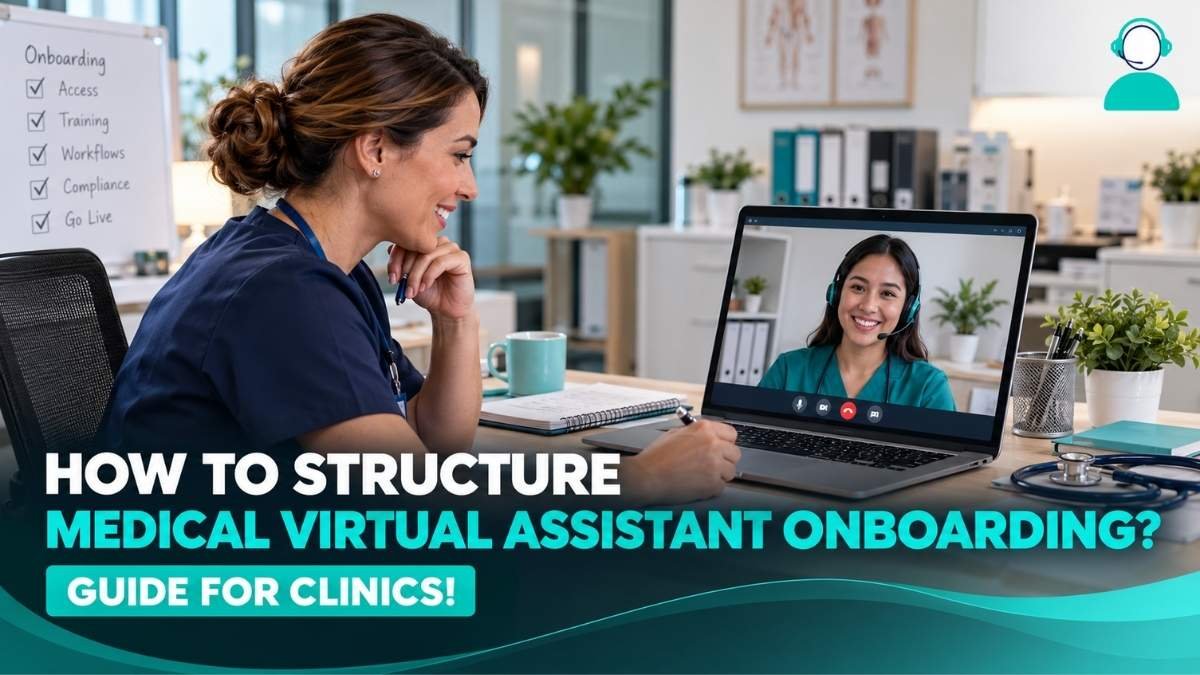
Onboarding a medical virtual assistant is a sequence, not a single event. Compliance training happens first, system access follows on a limited basis, and task ownership expands only after both are confirmed. Here is the detailed medical virtual assistant onboarding checklist:
Defining The Scope of A Medical Virtual Assistant Role
A virtual medical assistant role needs a written scope before anyone touches a system. Administrative tasks, scheduling, insurance verification, claims follow-up, and documentation support, belong on that list. Clinical judgment tasks do not.
A clear scope prevents the slow creep where a scheduling assistant starts fielding triage questions. This is why defining responsibilities while hiring a medical virtual assistant is just as important as establishing onboarding procedures.
Granting EHR and EMR System Access
Full-record access is rarely appropriate for a new hire, remote or otherwise. Role-based access control limits what a virtual assistant sees inside the EHR or EMR to the fields their tasks require. A scheduler needs calendar and contact data, not a full clinical history.
The HIPAA Privacy Rule’s minimum necessary standard requires reasonable efforts to limit access to what a task requires. Using an entire record is not automatically justified just because it is convenient.
HIPAA and PHI Compliance Training Requirements
Does a medical virtual assistant need HIPAA training before their first login? Yes. Training should happen before any protected health information becomes visible, not during the first week of live work.
A healthcare virtual assistant who creates, receives, maintains, or transmits PHI functions as a business associate under HIPAA. Privacy Rule, Security Rule, and Breach Notification Rule obligations apply from day one.
Training should cover permitted PHI uses, reporting obligations, and violation consequences, and it should be documented for audit purposes.
Setting Up Secure Remote Work Protocols
Remote access widens the attack surface a practice has to manage. A secure setup typically includes an encrypted VPN connection, multi-factor authentication, and limits on screen-sharing or file transfer outside approved platforms.
Personal devices without endpoint protection should never touch PHI. These protocols are not optional extras. They are the technical safeguards referenced directly inside a compliant Business Associate Agreement.
Assigning Initial Billing and Coding Tasks
New virtual assistants should start with lower-risk medical billing tasks, such as checking claim status or verifying eligibility, before moving into full medical coding work.
Documentation and coding errors are a leading driver of claim denials across the industry. A phased approach lets a supervisor confirm accuracy on smaller tasks first. Rushing this step is one of the more expensive onboarding mistakes a practice can make.
Establishing Patient Scheduling Workflows
Patient scheduling looks simple from the outside, but it touches PHI the moment a patient’s name links to an appointment reason. Give the assistant clear rules for confirmations, cancellations, and how to handle clinical questions during a scheduling call.
The right response to a clinical question is almost always a warm handoff to clinical staff, not an attempt to answer it directly.
Credentialing and Verification Steps
Credentialing here means verifying the virtual assistant’s own background, certifications, and any payer-facing requirements tied to their tasks.
This step should happen before system access is granted, not treated as paperwork to finish later. A practice that skips verification has no documented basis for trusting the person now handling patient data on its behalf.
Defining Escalation and Communication Procedures
Every onboarding plan needs a clear answer to one question: when does a task go back to in-house staff? Escalation procedures should cover clinical questions, unusual billing situations, and any request outside the documented scope.
Put this in writing. Confirm the assistant understands it before their first unsupervised task, rather than working it out informally later.
Which Administrative Tasks Can Be Delegated Safely

Not every administrative task carries the same risk. Some suit delegation well; others require licensed clinical judgment and should stay in-house regardless of staffing pressure.
| Task | Suitable For A Medical Virtual Assistant? | Notes |
| Insurance eligibility verification | Yes | Low clinical risk; high administrative value |
| Appointment scheduling | Yes | Requires clear scripts for clinical questions |
| Claims status follow-up | Yes | Straightforward once billing access is set up |
| Medical coding review | Conditional | Appropriate once trained and audited; not for new hires |
| Clinical documentation entry | Conditional | Data entry only; no interpretation of findings |
| Prescription decisions | No | Requires a licensed prescriber |
| Patient triage | No | Requires clinical judgment and licensure |
“We’re looking at ways to continue to improve their function so that they can be even more helpful to us. It has been pretty amazing in changing the way that our practice runs.” — Fran Saperstein, COO, Center for Complex Neurology EDS & POTS, in an MGMA Stat data story
| Compliance Tip |
|---|
| Any task involving PHI, even routine scheduling, falls under HIPAA the moment a patient can be identified. Do not assume a task is exempt just because it looks purely administrative. |
How HIPAA And Compliance Requirements Shape The Onboarding Process

Compliance is not a formality layered on top of onboarding. It determines the order of every other step, from access to training to task assignment. Following established HIPAA compliance best practices helps clinics protect patient information throughout this process.
A Business Associate Agreement must be signed before a virtual assistant receives any PHI access. The agreement should define permitted uses, required safeguards, breach notification duties, and what happens to data when the engagement ends.
CMS (Centers for Medicare and Medicaid Services) guidance and payer contracts add further documentation requirements for practices billing Medicare or Medicaid.
The minimum necessary standard under HIPAA requires reasonable efforts to limit PHI access to what a task requires. A scheduling assistant should not see full clinical notes. A billing assistant should not need a patient’s entire treatment history to submit a claim.
| Compliance box |
|---|
| A signed BAA should be in place before a virtual assistant receives any PHI access, not during or after onboarding. |
What A Typical Onboarding Timeline Looks Like
How long does it take to onboard a medical virtual assistant? Most practices see a functional timeline of two to four weeks, depending on task complexity and prior experience.
A common structure: week one covers compliance training and system familiarization without live PHI access. Week two introduces shadowing on real tasks under supervision.
Week three moves into supervised independent work. By week four, most assistants handle routine tasks independently, with billing or coding still subject to periodic audit.
| Common Mistake |
|---|
| Skipping the shadowing period and moving a virtual assistant straight into live scheduling or billing tasks. This shortcut tends to produce more errors, since mistakes surface after the fact rather than during a controlled trial run. |
How To Evaluate Staffing Efficiency After Onboarding

A practice cannot judge onboarding success by gut feeling alone. A handful of operational metrics make the outcome measurable.
- Task turnaround time – how quickly scheduling requests, claims follow-ups, or verification tasks complete compared to the prior baseline.
- Billing error rate – the share of claims returned for correction after the assistant takes on coding or billing support.
- Scheduling accuracy – double-bookings, missed confirmations, or cancellations handled incorrectly.
- Cost per task versus an in-house hire – factoring in salary, benefits, and overhead against the virtual assistant’s rate.
Tracking these figures for the first 90 days gives a manager a factual basis for expanding the role, adjusting its scope, or reconsidering the arrangement. Understanding the ROI of using virtual assistants in healthcare also helps practices compare operational savings against staffing costs.
Common Onboarding Mistakes And How To Avoid Them
Unclear task boundaries cause more onboarding problems than any technical failure. When a virtual assistant is not told what falls outside their role, they either overstep or under-deliver.
The fix is a written scope reviewed with the assistant and the supervising staff member before work begins.
Insufficient EHR training is a close second. An assistant who has not walked through a practice’s specific fields and workflows will make avoidable errors early on. Structured shadowing during week one addresses this directly.
Delayed compliance training creates legal exposure unrelated to the assistant’s competence. Training on PHI handling after access has already been granted defeats the purpose of the requirement. Sequence training before access, not alongside it.
A missing escalation path is the quieter mistake. Without one, an assistant facing an ambiguous situation will guess. Guessing on a billing or patient question is where costly errors tend to start.
Frequently Asked Questions (FAQs)
How long does it take to onboard a medical virtual assistant?
Most practices complete onboarding in two to four weeks, moving from compliance training through supervised shadowing to independent task ownership.
Does a medical virtual assistant need HIPAA training before starting?
Yes. Training should happen before any PHI access is granted, since the assistant becomes a business associate once they handle identifiable patient data.
Can a medical virtual assistant handle medical coding?
Trained and audited assistants can. New hires should start with lower-risk billing work, like eligibility checks, before taking on full coding duties.
What EHR access should a virtual assistant have during onboarding?
Access should be role-based and limited to fields their tasks require, consistent with the HIPAA minimum necessary standard, rather than full record visibility.
Final Thoughts
Medical virtual assistant onboarding works best as a fixed sequence: compliance training first, system access second, task delegation last. Practices that skip steps, particularly HIPAA training or clear task boundaries, tend to see more errors and rework later.
Tracking turnaround time, accuracy, and cost against in-house staffing gives managers a factual basis for judging whether onboarding works, rather than relying on impressions alone.