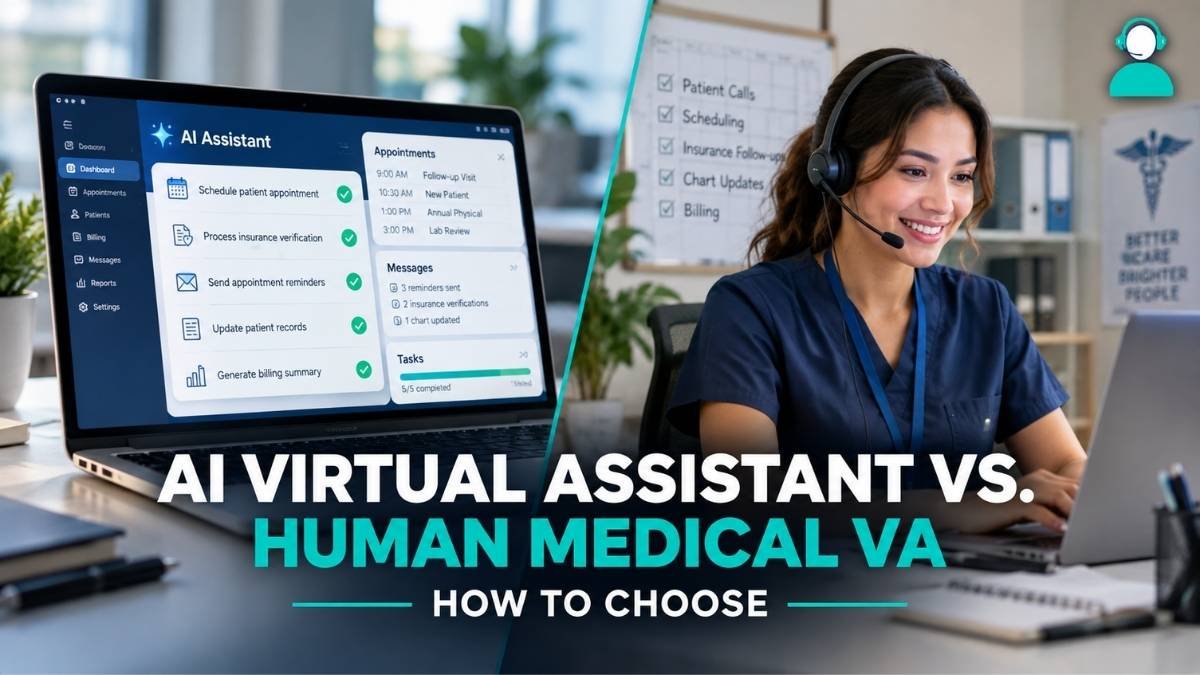

Administrative workload is one of the most common reasons physicians consider leaving clinical practice. Charting, prior authorization, and inbox management often consume hours that once belonged to patient care.
Practice leaders are asking a practical question: how virtual assistants can reduce physician burnout without adding full-time headcount or overtime costs. The answer starts with understanding which tasks can be delegated safely and which require licensed staff.
Medical clinics, dental practices, and veterinary groups all face similar pressure from staffing shortages and rising documentation demands.
This article breaks down where virtual medical assistants fit into daily operations, what compliance boundaries apply, and how results should be measured. The goal is operational clarity, not a general case for outsourcing.
What Physician Burnout Looks Like In Day-To-Day Practice
Physician burnout is measurable, not abstract. It shows up in after-hours charting, delayed inbox responses, and shrinking time for direct patient interaction. Understanding these patterns is the first step toward addressing them operationally.
National data confirm what many practice leaders already observe. In 2025, 41.9% of physicians reported at least one burnout symptom.
“Burnout varies widely by medical specialty, driven by differences in workload, administrative burden, clinical environment, staffing support, and the day-to-day realities of practice.”
— Bobby Mukkamala, MD, AMA President
Documentation time reinforces this pattern. Primary care physicians spend an average of 36.2 minutes on the electronic health records (EHR) per office visit. That figure comes from activity-log data at two teaching hospitals, and much of the time falls outside scheduled clinic hours.
How Virtual Assistants Can Reduce Physician Burnout

This section outlines where a medical virtual assistant fits into daily workflows. Each task category below reflects work that does not require a physician’s clinical judgment to complete safely.
1. Delegating Clinical Documentation and Chart Prep
A medical virtual assistant can prepare charts before a visit and organize documentation afterward.
This includes reviewing prior records, flagging missing labs, and formatting visit notes for physician review. Unlike live scribing, this work happens asynchronously, before or after the patient encounter.
Physicians still enter clinical decisions and sign off on final notes. The task shift is chart preparation and formatting, not diagnosis or interpretation.
Clinics using this model often report shorter documentation sessions at the end of each day, since the groundwork is already organized.
2. Managing Patient Scheduling and Calendar Coordination
Scheduling touches nearly every part of clinic operations. A virtual assistant can confirm appointments, manage cancellations, and coordinate calendar changes across multiple providers.
This reduces the volume of scheduling calls that reach front-desk staff during peak hours. Fewer scheduling conflicts also mean fewer disruptions to a physician’s daily patient flow. Consistent patient scheduling support
improves patient satisfaction, since confirmations and reminders reduce no-show rates. None of this work requires clinical training, making it a reasonable starting point for delegation.
3. Handling Prior Authorization Requests
Prior authorization is one of the heaviest administrative burdens in medical practice. AMA survey data show physicians and their staff spend about 13 hours per week on the process, completing 40 requests on average.
Ninety-four percent of physicians say it contributes to burnout. A virtual assistant can complete authorization forms, track submission status, and follow up with payers.
Clinical justification and medical necessity documentation still require physician or clinical staff input. Splitting the process this way keeps licensed staff focused on judgment calls instead of paperwork submission.
4. Supporting Billing and Coding Accuracy
Billing and coding accuracy directly affects revenue cycle management and claim turnaround. A virtual assistant can prepare claims, verify patient demographic and insurance data, and flag documentation gaps before submission.
Final coding decisions typically remain with certified coders or billing supervisors, particularly for complex claims.
This division keeps compliance responsibility with qualified staff. Delegating preparatory steps reduces manual data entry for billing teams. This can shorten the time between service delivery and claim submission.
5. Reducing EHR Inbox and Message Overload
Patient message volume has grown steadily across most EHR platforms. A virtual assistant can triage routine messages such as refill requests, appointment questions, and results notifications that require no clinical interpretation.
Messages involving symptoms, medication changes, or clinical judgment route directly to the physician or nursing staff.
This structure prevents inbox backlog without removing clinical oversight from patient communication. Clear, documented routing rules are what make this delegation model function safely, not the assistant’s independent judgment.
Here is a detailed breakdown of the tasks a medical virtual assistant can do.
Medical Scribes Vs. Virtual Assistants: Where The Roles Diverge

Medical scribes document in real time during the patient visit, working alongside the physician. Virtual assistants typically operate asynchronously, supporting scheduling, billing, and administrative tasks outside the exam room.
Some healthcare virtual assistant roles combine both functions, but the distinction matters for staffing decisions. A practice needing real-time documentation support has different requirements than one needing administrative task delegation.
Clarifying this distinction before hiring or contracting prevents mismatched expectations about scope of work and daily availability.
Compliance and Data-Access Boundaries
Any virtual medical assistant handling protected health information falls under HIPAA requirements. Practices need a signed business associate agreement before granting system access.
Role-based permissions should limit access to only the data necessary for assigned tasks. Audit logs help track who accessed records and when. These boundaries are baseline requirements for any healthcare virtual assistant arrangement, not optional extras.
Practices that skip this step create compliance exposure that outweighs the administrative time saved.
Deciding Which Tasks To Delegate First
Not every administrative task should be delegated at once. Practice leaders should start with high-frequency, low-risk tasks such as scheduling or message triage. Tasks requiring licensure, such as final coding sign-off, should stay with credentialed staff.
Reviewing task frequency, error risk, and documentation requirements helps determine a reasonable delegation order. A phased approach also gives staff time to build trust in the new workflow before it expands further.
Virtual Medical Assistants Vs. In-House Staffing Models
Comparing virtual assistant models to traditional in-house hiring clarifies cost, onboarding, and scalability differences. Neither model fits every practice equally well.
In-house hires typically require longer onboarding, benefits administration, and office space. Virtual assistants can often start sooner and scale based on patient volume. The table below outlines common differences practice leaders weigh.
| Factor | In-House Staff | Virtual Medical Assistant |
|---|---|---|
| Onboarding Time | Weeks to months, including credentialing | Days to a few weeks |
| Cost Structure | Salary, benefits, payroll taxes, office space | Contracted or hourly fee, no benefits overhead |
| Scalability | Fixed headcount, slow to adjust | Flexible hours based on patient volume |
| Licensure Requirements | Required for clinical tasks (MA, RN) | Typically non-licensed; clinical tasks stay in-house |
| Coverage Flexibility | Limited by shift schedules and PTO | Extended hours possible without overtime pay |
Read this detailed comparison of medical virtual assistants vs. in-house staff.
Workflow Automation And Digital Health Tools That Support Virtual Assistant Integration

Workflow automation and EHR-integrated digital health tools make virtual assistant delegation more reliable. These systems create structure around task routing and accountability.
Secure messaging platforms and task-routing software give virtual assistants clear boundaries for what they can access. EHR integration allows documentation and scheduling updates to sync in real time, reducing duplicate data entry.
Audit trails built into these tools support compliance reviews. Practices that adopt structured digital health tools before expanding delegation tend to see fewer errors during the transition.
| Common Mistake |
|---|
| Delegating tasks without documented protocols. Assign specific task types, define escalation paths, and confirm system access levels before a virtual assistant begins work. Undefined scope creates confusion for both the assistant and clinical staff |
Common Risks And Mistakes When Delegating Administrative Work
Delegation introduces new risks alongside its benefits. Recognizing common mistakes early prevents compliance gaps and workflow breakdowns.
Inadequate training is the most frequent cause of delegation failures. Staff need clear instructions, not general task descriptions, to perform consistently. Unclear escalation paths also cause delays when a task requires clinical input.
One practice leader told MGMA that nonclinical shortages “affect the ability… to efficiently move patients through the system.” Defined scope-of-work agreements reduce that ambiguity.
| Compliance Tip |
|---|
| Confirm a signed business associate agreement is in place before granting a virtual assistant access to any system containing protected health information. Verbal agreements do not meet HIPAA documentation requirements. |
Measuring Whether Virtual Assistant Support Is Working
Delegation decisions should be reviewed against measurable outcomes, not general impressions. Tracking specific metrics shows whether the arrangement is reducing administrative burden.
Useful metrics include after-hours charting time, average message response time, and prior authorization turnaround. Patient satisfaction scores and claim denial rates also show whether delegated tasks are completed accurately.
Researcher A. Jay Holmgren, PhD, has studied after-hours EHR use. He noted that this pattern “is really conducive to burnout,” which is why charting time is worth tracking.
Reviewing these numbers at a set interval gives practice leaders a clearer signal of whether delegation is working.
| Best Practice |
|---|
| Set a 90-day review checkpoint after introducing virtual assistant support. Compare documentation time, message backlog, and denial rates against pre-delegation baselines. |
Virtual assistants reduce physician burnout by taking on administrative tasks such as clinical documentation support, patient scheduling, prior authorization follow-up, and billing preparation, freeing physicians to focus on direct patient care instead of after-hours paperwork.
Final Thoughts
Physician burnout is closely tied to administrative workload, not just patient volume. Understanding how virtual assistants can reduce physician burnout starts with identifying which tasks can be delegated safely.
Documentation prep, scheduling, authorization follow-up, and billing support are common starting points, provided compliance oversight stays in place. The most effective implementations start small, with documented protocols and measurable checkpoints.
For clinic decision-makers, the practical takeaway is simple: pick one bottleneck, delegate it with clear boundaries, then evaluate results before expanding scope.
References
- American Medical Association, “Physician burnout rates are falling, specialty gaps remain,” 2025 Organizational Biopsy report
- American Medical Association, “Latest prior auth survey shows promised reform remains elusive,” 2025 Prior Authorization Physician Survey
- American Medical Association, “Primary care visits run a half hour. Time on the EHR? 36 minutes,” 2024
- American Medical Association, “Another challenge for resident physicians: more ‘pajama time,'” 2023
- MGMA, “Reshaping your medical practice staffing strategies for 2025”
https://www.mgma.com/mgma-stat/reshaping-your-medical-practice-staffing-strategies-for-2025