Running a healthcare practice in the U.S. often means juggling far more than patient care. Administrative work, scheduling, insurance checks, documentation, can quietly take up 15–20 hours per week, slowing down operations and increasing staff burnout.
Medical virtual assistants are quickly becoming a practical solution. They help streamline non-clinical workflows, improve patient coordination, and give providers back the time they need to focus on care.
But hiring the right medical VA isn’t just about outsourcing tasks, it requires a clear process, the right skill match, and strict attention to compliance.
In this guide, you’ll learn exactly how to hire a medical virtual assistant in USA, what tasks to delegate, and how to set them up for success. So, you start seeing real operational improvements within the first few months.
What Is A Medical Virtual Assistant (And What They Actually Do)
A medical virtual assistant is a remote professional trained specifically to handle healthcare-related administrative and operational tasks.
Unlike general virtual assistants, MVAs understand medical terminology, patient workflows, and compliance requirements, making them suitable for clinics, private practices, and healthcare organizations.
They work remotely but integrate directly into your daily operations, often becoming just as essential as in-house staff.
Core Responsibilities of A Medical VA
A skilled medical virtual assistant can take over a wide range of time-consuming tasks, including:
- Appointment scheduling and calendar management
- Insurance verification and eligibility checks
- Medical billing and coding support
- Patient communication (calls, follow-ups, reminders)
- EHR/EMR data entry and documentation support
By offloading these responsibilities, providers can focus more on patient care instead of paperwork.
Tasks You SHOULD Vs. SHOULD NOT Delegate
Understanding what to delegate, and what to keep in-house, is critical for both efficiency and compliance.
SHOULD Delegate
These tasks are safe, high-impact, and ideal for a medical VA:
- Administrative workflows (scheduling, reminders, inbox management)
- Insurance and billing-related processes
- Documentation support and data entry
- Patient coordination and non-clinical communication
SHOULD NOT Delegate
These tasks must remain with licensed professionals:
- Diagnosis or treatment decisions
- Clinical assessments
- Prescribing medications
- Any activity requiring medical licensure
A simple rule: if it directly impacts clinical judgment, it should stay with your in-house medical team.
Why US Clinics Are Hiring Medical Virtual Assistants
The shift toward virtual staffing isn’t just a trend—it’s a response to real operational challenges in the U.S. healthcare system. From rising labor costs to staffing shortages, clinics are looking for smarter, more scalable ways to operate.
Medical virtual assistants offer exactly that.
Key Benefits
- Significant Cost Savings
Hiring a full-time, in-house administrative employee in the U.S. can cost $40,000–$60,000+ annually (including benefits). In contrast, a medical VA delivers similar output at a fraction of the cost.
- Increased Patient Capacity
When administrative bottlenecks are removed, providers can see more patients without extending hours—directly increasing revenue.
- Reduced Burnout
Less paperwork means less stress. Physicians and staff can focus on meaningful work instead of repetitive admin tasks.
- Faster, Simple Operations
From quicker appointment handling to efficient billing cycles, workflows become smoother and more predictable.
Real ROI Breakdown
Let’s break this down in practical terms.
- Monthly Cost Range
Typically between $1,500–$4,000 depending on role and experience
- Annual Savings
Compared to in-house staff, clinics often save $25,000–$45,000 per year
- Time-to-ROI
Most practices start seeing measurable returns within 3 to 6 months
Mini Case Example
A small private clinic struggling with appointment backlogs and delayed insurance verification hired a part-time medical virtual assistant.
Within the first 60 days:
- Appointment scheduling efficiency improved by over 40%
- Insurance verification turnaround dropped from 48 hours to same-day
- Front-desk staff workload reduced significantly
By month three, the clinic was able to increase daily patient volume without hiring additional in-house staff, resulting in both higher revenue and improved patient satisfaction.
These early gains highlight why more U.S. clinics are shifting toward virtual support, not just to cut costs, but to build more resilient and scalable operations.
Also Read: How Virtual Assistants Support Telehealth Practices?
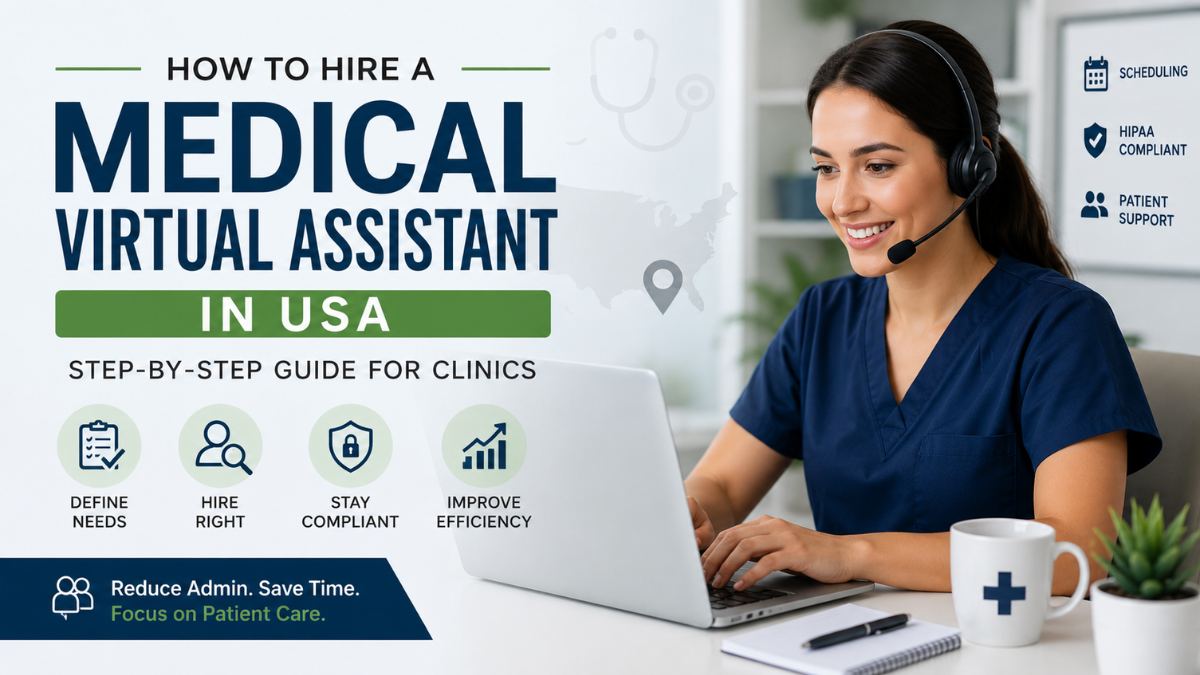
How To Hire A Medical Virtual Assistant In USA?

This is where most practices either set themselves up for long-term efficiency, or end up with a frustrating, short-lived hire. The difference isn’t luck. It’s process.
Follow these seven steps to hire a medical virtual assistant the right way, with compliance, performance, and ROI in mind.
Step 1 – Define Your Needs Clearly
Before you even look at candidates, get specific about what you actually need. Vague hiring leads to mismatched expectations and poor performance.
Start by identifying:
Tasks to outsource
- Appointment scheduling
- Insurance verification
- Billing and coding
- Patient follow-ups
- EHR documentation support
Hours required
- Part-time (10–20 hours/week)
- Full-time (30–40 hours/week)
Skill level
- Entry-level admin support
- Specialized billing/coding
- Medical scribe or advanced documentation
| Pro Tip Start small. Hiring for 1–2 high-impact tasks first often delivers faster ROI and smoother onboarding. |
Step 2 – Choose The Right Hiring Model
Not all hiring paths are equal. Your choice affects cost, control, and compliance responsibility.
Option 1: Direct Hire (Freelancer)
- Cost: Lowest
- Control: High
- Compliance Responsibility: Fully on you
Best for experienced practices that already have systems and SOPs in place.
Option 2: Agency or Vendor
- Cost: Higher than freelancers
- Control: Moderate
- Compliance Responsibility: Shared or handled by agency
Best for clinics that want pre-trained, healthcare-specific VAs with minimal setup.
Option 3: Independent Contractor (Hybrid)
- Cost: Mid-range
- Control: Moderate to high
- Compliance Responsibility: Mostly on you
Best for practices wanting flexibility without full agency costs.
| Decision Insight If compliance and training feel overwhelming, an agency model often reduces risk early on, even if it costs more upfront. |
Step 3 – Screen For Healthcare-Specific Skills
A general virtual assistant is not enough in a medical setting. You need someone who understands the ecosystem.
Focus your screening on:
- Medical terminology (accuracy matters in documentation)
- EHR/EMR systems (such as Epic, Cerner, Athenahealth)
- Billing and coding basics (ICD-10, CPT familiarity)
- Communication skills (professional, patient-friendly tone)
What to look for:
Candidates who have worked with U.S.-based clinics before will ramp up significantly faster and require less training.
Step 4 – Verify HIPAA Compliance (CRITICAL)
This step is non-negotiable. A single compliance mistake can lead to serious financial and legal consequences.
Make sure your candidate or provider has:
- HIPAA training certification
- Signed BAA (Business Associate Agreement)
- Secure tools and workflows (encrypted communication, password protocols)
- Role-based access control (limited access to sensitive data)
| Important HIPAA violations can cost up to $1.5 million annually, depending on severity. Cutting corners here is never worth the risk. |
Step 5 – Interview The Right Way
A standard interview won’t reveal how a candidate performs in real healthcare workflows. You need to go deeper.
Include:
Scenario-Based Questions
- “How would you handle a denied insurance claim?”
- “What steps would you take if a patient misses an appointment?”
Workflow Simulation
- Give a mock task (e.g., scheduling + insurance verification)
- Evaluate speed, accuracy, and communication
Compliance Awareness
- Ask how they handle patient data
- Check understanding of privacy protocols
Sample Interview Questions
- How do you ensure accuracy when entering patient data into an EHR?
- Can you walk me through your process for verifying insurance eligibility?
- What steps do you take to maintain HIPAA compliance while working remotely?
- How do you prioritize tasks when handling multiple patients?
| Pro Tip Strong candidates answer with structured processes, not vague explanations. |
Step 6 – Run A Paid Trial Or Test Task
Never skip this step. A resume can look perfect, but real performance tells the truth.
Set up a 1–2 week paid trial with:
- Real (but controlled) tasks
- Clear expectations and deadlines
- Measurable outcomes
Evaluate:
- Accuracy
- Speed
- Communication
- Ability to follow SOPs
| Insight Even top candidates need workflow alignment. The trial helps you test fit without long-term risk. |
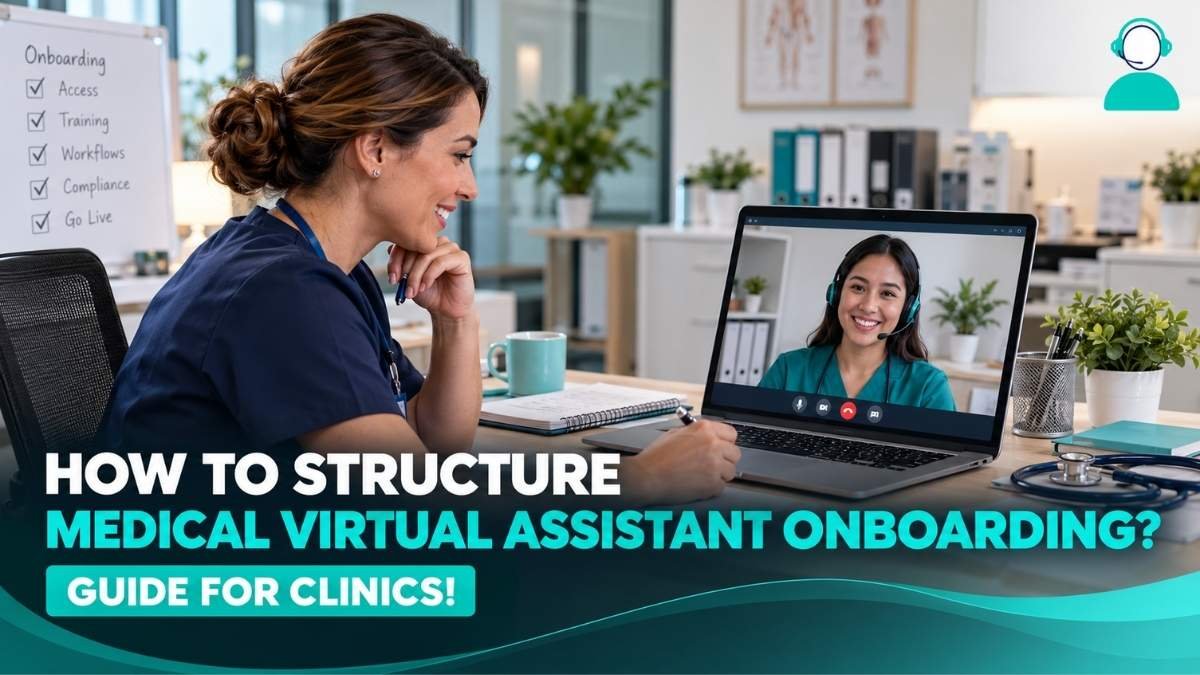
Step 7 – Onboard With A 30-60-90 Day Plan
Hiring is only half the equation. Proper onboarding is what turns a good hire into a high-performing one.
First 30 Days
- Tool setup (EHR, communication platforms)
- SOP training
- Shadowing workflows
60 Days
- Independent task execution
- Performance feedback
- Process refinement
90 Days
- Full integration into daily operations
- KPI tracking
- Optimization and scaling responsibilities
Example Onboarding Checklist
- Access to all required tools and systems
- HIPAA compliance documentation signed
- SOPs for each assigned task
- Defined KPIs (e.g., scheduling accuracy, turnaround time)
- Weekly check-in schedule
| Key Takeaway Most hiring failures don’t happen because of bad candidates, they happen due to poor onboarding and unclear expectations. |
With these 7 steps in place, you’re not just hiring a medical virtual assistant, you’re building a scalable system that supports growth, compliance, and long-term efficiency.
How To Get The Best Results From Your Medical VA
Hiring a medical virtual assistant is only the beginning. The real value comes from how you manage your virtual assistant and integrate them into your workflow and systems. Clinics that treat their VA like a core team member, not just extra help, see the fastest and most sustainable results.
Start with a focused, structured approach.
Start with 1–2 high-impact tasks
Avoid overwhelming your VA on day one. Begin with tasks like appointment scheduling or insurance verification, areas where improvements are immediately measurable.
Use SOPs (Standard Operating Procedures)
Clear, documented workflows eliminate confusion and reduce errors. Even a simple checklist or screen recording can dramatically improve performance and consistency.
Track KPIs from the beginning
Define success early. Examples include:
- Appointment scheduling accuracy
- Insurance verification turnaround time
- Patient response time
- Billing error rates
What gets measured gets improved.
Hold weekly check-ins
Short, consistent meetings help:
- Address bottlenecks early
- Improve communication
- Align expectations
| Insight The most successful clinics don’t just “delegate,” they build repeatable systems around their VA. That’s where real scalability happens. |
Frequently Asked Questions (FAQs)
How long does it take to hire a medical VA?
Hiring a medical virtual assistant typically takes 1 to 3 weeks, depending on your hiring method. Agency hires are faster, while direct hiring may take longer due to screening and interviews.
Are medical virtual assistants HIPAA compliant?
Yes, many medical virtual assistants are trained in HIPAA compliance, but you must verify certifications and sign a Business Associate Agreement. Compliance ultimately remains your responsibility as a healthcare provider.
Can they access EHR systems safely?
Yes, medical VAs can securely access EHR systems using encrypted tools and role-based permissions. Proper access control and secure workflows are essential to maintain patient data protection.
What tasks should I outsource first?
Start with repetitive, time-consuming tasks like scheduling, insurance verification, and patient follow-ups. These deliver quick efficiency gains without involving complex clinical responsibilities.
Is hiring offshore legal in the USA?
Yes, hiring offshore medical virtual assistants is legal in the U.S. as long as HIPAA compliance and data protection standards are followed. Proper agreements and secure systems are critical.
Final Thoughts
Hiring a medical virtual assistant in the U.S. is no longer just a cost-cutting tactic—it’s a strategic move toward building a more efficient, scalable, and resilient healthcare practice.
When done right, it allows you to:
- Reduce operational costs significantly
- Free up valuable clinical time
- Improve patient experience
- Scale without the burden of traditional hiring
The key isn’t just hiring a VA, it’s hiring the right one, with a clear process, strong compliance foundation, and structured onboarding.
If you follow the steps outlined in this guide, you’re not just filling a role. You’re creating a system that supports long-term growth, better care delivery, and a more balanced workload for your entire team.
And in today’s healthcare space, that kind of leverage is no longer optional, it’s essential.