Coordinating patient scheduling, billing, and front desk coverage gets harder with each new location a practice opens. A billing supervisor at one site rarely has visibility into scheduling conflicts at another. Insurance verification backlogs at a second office can go unnoticed until claims are already denied.
These gaps are not staffing failures, they are structural, built into how practices scale by adding locations without adding coordination.
Understanding how virtual assistants support multi-location practices starts with recognizing where that coordination breaks down. Administrative leaders overseeing physician groups, dental practices, and veterinary clinics face this daily.
Why Multi-Location Practices Face Different Administrative Pressures
Administrative complexity does not scale evenly as a practice adds locations. Each additional site introduces separate scheduling calendars, billing queues, and staff routines that rarely stay aligned without active coordination.
A single-location practice can rely on one front desk team that knows every provider’s schedule and insurance quirk. Multi-location physician groups do not have that option. A patient calling one site may need an appointment at another.
Billing follows a similar pattern. Claims queued at one office can sit unprocessed while attention shifts to a busier location. Documentation habits can drift between sites without anyone noticing until a denial arrives.
Medical office managers overseeing several locations often describe this as constant catch-up.
How Virtual Assistants Support Multi-Location Medical Practices

Healthcare virtual assistants take on specific, well-defined administrative tasks that would otherwise fall unevenly across separate front desks. The sections below break down where that support fits within daily operations.
1. Centralizing Patient Scheduling Across Locations
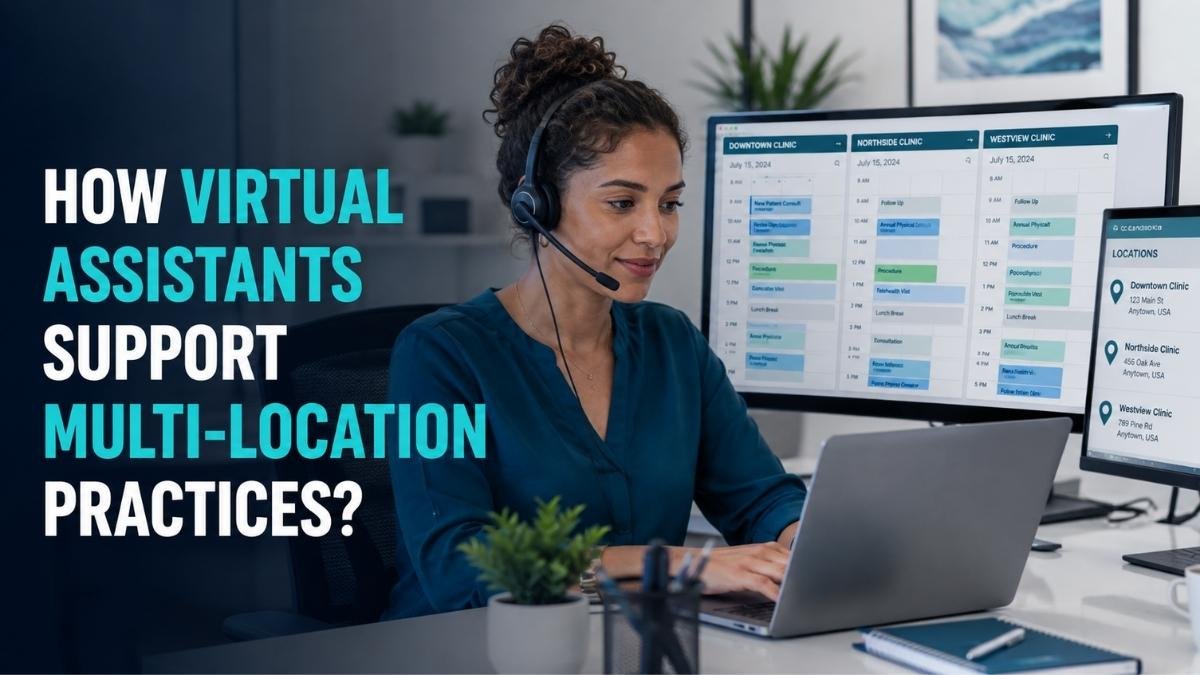
A centralized virtual assistant team manages appointment booking for every location from one shared calendar.
This reduces the chance that a patient is booked with the wrong provider or double-booked across sites. Patient scheduling becomes consistent regardless of which office the call originates from.
Staff no longer need to transfer callers between locations to find an open slot. A virtual medical assistant working across multiple calendars can also flag scheduling gaps before they affect patient volume at a specific site.
2. Supporting Medical Billing and Claims Follow-Up
Virtual assistants can support medical billing by tracking claim status, following up on unpaid balances, and flagging accounts that need attention from a credentialed biller. This keeps claims moving instead of sitting untouched at a slower location.
Delegated tasks typically include claim status checks, payment posting, and patient balance follow-up calls.
Final coding decisions and complex appeals still require a certified biller’s review. A virtual medical assistant supports the billing cycle. It does not replace the judgment a licensed biller applies to disputed claims.
3. Handling Insurance Verification Before Appointments
Insurance verification completed before a visit reduces same-day cancellations and unexpected balances. A virtual assistant can confirm eligibility, benefits, and prior authorization requirements days ahead of an appointment across every location a practice operates.
This matters because denial rates tied to eligibility and authorization issues remain persistent.
Revenue-cycle data from Kodiak Solutions shows payers are “using initial denials to slow payments” even though most claims are eventually paid. Pre-visit verification catches these issues before a claim is submitted.
4. Assisting With Electronic Health Records Data Entry
Virtual assistants can handle intake data entry, chart preparation, and documentation support within Electronic Health Records (EHR) systems. This includes entering demographic information, uploading referral documents, and organizing records ahead of a visit.
Clinical documentation and diagnosis-related entries remain the provider’s responsibility.
A virtual assistant’s role is limited to administrative data entry that supports the record, not clinical decision-making. Keeping this boundary clear protects documentation accuracy across locations sharing the same practice management software.
5. Coordinating Care Between Sites and Providers
Care coordination across locations often breaks down when referral information does not follow the patient. A virtual medical assistant can track referrals, confirm they were received at the correct site, and follow up on missed appointments.
This role works best when one team has visibility across every location, rather than each office tracking referrals independently. Physician groups with several specialties benefit most, since patients frequently move between sites for different types of care.
Also Read: How Medical Virtual Assistants Support Specialty Practices?
6. Managing Front Desk Operations Remotely
Remote staff can answer calls, reschedule appointments, and manage waitlists for multiple front desk operations at once. A patient calling any location reaches the same trained team, rather than whoever happens to be available on-site that day.
This reduces missed calls during peak hours and covers gaps when on-site staff are occupied with in-person patients. Patient communication stays consistent across every office, since the same team handles calls regardless of location.
7. Supporting Telehealth Coordination and Follow-Up
Telehealth visits require setup, reminders, and follow-up instructions that are easy to miss during a busy day. A virtual medical assistant can confirm technology access before a visit and send follow-up instructions afterward.
This support matters most for practices running telehealth across several locations with different scheduling habits. Consistent follow-up reduces missed virtual appointments and keeps documentation aligned with in-person visit standards.
Comparing In-House Staff Vs. Virtual Assistants For Multi-Site Coordination
Deciding between in-house staff and a centralized team depends on call volume, location count, and how much local knowledge each site requires.
| Factor | In-House Staff Per Location | Centralized Virtual Assistant |
| Scheduling consistency | Varies by site and staff | Standardized across all locations |
| Coverage during peak call volume | Limited to on-site staff | Scalable remote coverage |
| Insurance verification turnaround | Dependent on front desk bandwidth | Processed ahead of the visit |
| Cost structure | Salary and benefits per location | Task-based or hourly |
| EHR access | Full local access | Role-based, limited access |
HIPAA Compliance And Data Access In A Remote Workforce Model

Delegating administrative tasks to a remote team raises legitimate questions about data access. HIPAA compliance requirements apply the same way to virtual medical assistants as they do to in-house staff.
A virtual assistant should only access the specific systems required for an assigned task, not the full patient record. Role-based permissions within electronic health records and practice management software limit exposure if credentials are compromised.
Federal regulation requires covered entities to obtain assurances that any vendor handling patient information will protect it under HIPAA’s rules, an obligation that covers most virtual assistant arrangements.
| Compliance Note |
|---|
| A virtual assistant should only have role-based access to the specific systems required for their task. A signed business associate agreement and documented access logs are baseline requirements, not optional extras. |
Which Billing And Administrative Tasks Should Not Be Delegated
Not every task fits a remote support model. Certain billing and clinical decisions require oversight from licensed staff who remain accountable for accuracy.
Final coding sign-off and appeals involving clinical judgment should stay with a credentialed biller or coder. A virtual medical assistant can gather documentation for an appeal but should not determine its clinical justification.
Sensitive patient complaints also warrant direct staff involvement. Delegating an entire billing cycle without a credentialed reviewer in the loop creates exposure, even when each individual task is appropriate on its own.
| Common Mistake |
|---|
| Practices sometimes hand off an entire billing cycle to a remote assistant without keeping a credentialed biller in the review loop. This creates compliance exposure even when the assistant’s individual tasks are appropriate. |
Evaluating Whether A Virtual Assistant Model Fits Your Practice
Fit depends on operational specifics, not general preference. A few factors determine whether centralized remote support solves a real coordination problem.
Practices considering this model should look at:
- Number of active locations and whether scheduling is already siloed by site
- Current front desk call volume and average hold times
- Insurance verification delays that lead to cancellations
- Compatibility between existing practice management software and remote access
- Internal capacity to oversee a remote team’s task list
Operations managers and billing supervisors are usually best positioned to audit these factors.
| Operational Note |
|---|
| Practices with three or more locations tend to see the clearest coordination gains, since scheduling and billing inconsistencies compound faster once a third site is added. |
Recent revenue-cycle research describes denial-related rework as “a growing part of everyday operations” for practices of every size, a pressure that compounds quickly once coordination spans multiple sites.
Frequently Asked Questions (FAQs)
What tasks can a virtual assistant handle for a multi-location medical practice?
Scheduling, insurance verification, billing follow-up, EHR data entry, and front desk calls across all locations.
Is it HIPAA compliant to use a virtual assistant for patient scheduling?
Yes, provided the assistant has role-based access, a signed business associate agreement, and logged access.
How does a virtual assistant access electronic health records securely?
Through limited, role-based permissions tied to the assigned task, not full record access.
Can a virtual assistant handle medical billing across multiple locations?
Virtual assistants can support claim tracking and follow-up calls, while coding and appeals stay with a credentialed biller.
Final Thoughts
Multi-location practices face administrative friction that increases with each site added, inconsistent scheduling, delayed insurance verification, and fragmented billing follow-up.
Recognizing how virtual assistants support multi-location medical practices starts with mapping which tasks are already duplicated across locations.
Success depends on clear access limits, HIPAA safeguards, and keeping licensed staff involved in decisions requiring their judgment. Practice leaders evaluating this model should begin with an honest audit of where coordination breaks down today.