
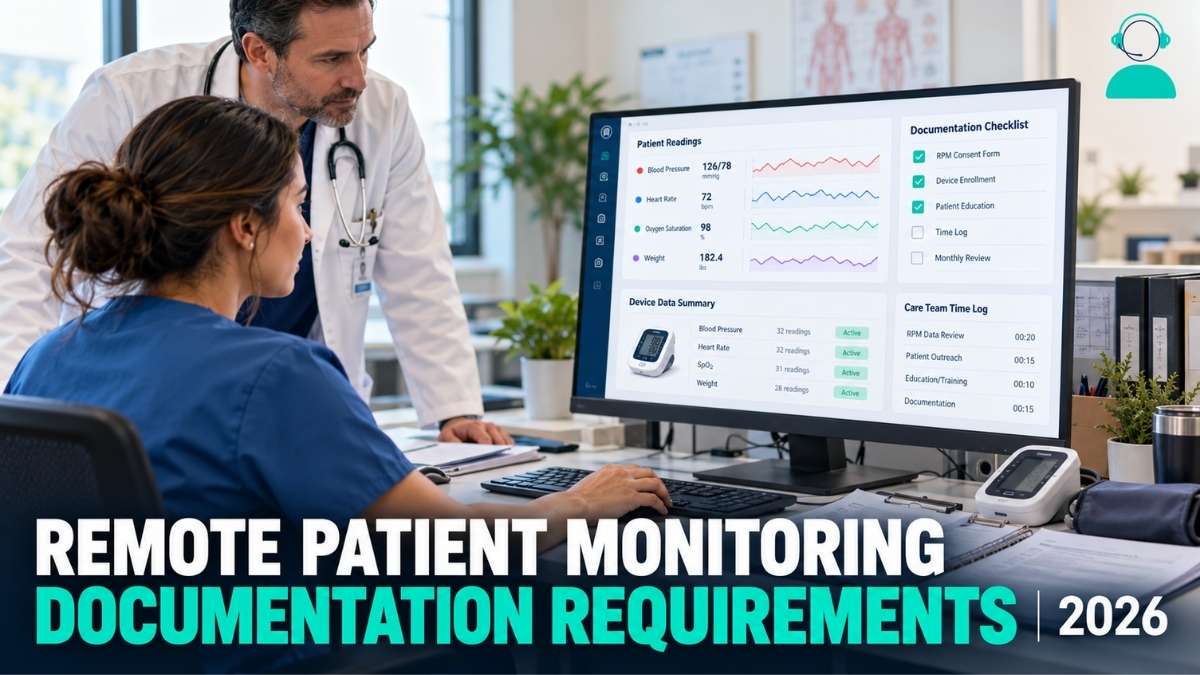
Remote patient monitoring (RPM) claims often fail for simple reasons. The chart shows device readings, yet it lacks a consent date, a minute log, or a count of transmission days. Practice leaders usually find the gap only after a payer request arrives.
Remote patient monitoring documentation requirements determine whether a service is paid and whether it survives an audit.
Reviewers look for records that match the billed code month by month. CMS added CPT 99445 and 99470 for 2026, which created new proof points for shorter months.
This article explains the Medicare record for each CPT code and which staff role owns each task. Rules shown apply to Medicare, and other payers may differ. Medical practices are the focus, since dental and veterinary billing follows different rules.
Key Takeaways
- RPM records must prove eligibility, consent, setup, transmission days, and clinical time.
- CPT 99445 and 99470 added shorter-month billing in 2026, each with its own proof.
- Time logs and treatment management notes carry the most audit risk.
- Each record needs a named owner, either clinical or administrative.
Remote Patient Monitoring Documentation Requirements For Medicare

Medicare treats RPM as a professional service that needs a clear paper trail. The record should prove eligibility, consent, device setup, transmitted data, and clinical time. Each item below maps to specific evidence in the chart.
Short answer. RPM documentation must show an established patient relationship, medical necessity, consent, device setup, transmitted data days, and clinical time.
Each entry belongs in the medical record and must match the billed CPT code. Other payers may add stricter rules of their own.
Eligibility, Order, And Medical Necessity
CMS requires an established patient relationship before remote physiologic monitoring begins, according to its Telehealth and Remote Monitoring booklet.
The record should name the acute or chronic condition and explain why home data supports treatment decisions.
That explanation forms the core of RPM medical necessity documentation. OIG recommended that CMS require an order with ordering provider details, so a signed order is a sound safeguard.
A recent visit note linking the patient to the billing practitioner settles the relationship question.
Informed Consent Documentation
CMS requires patient consent at the time RPM services are provided. These RPM consent requirements cover the whole service, including device supply and monthly management. The record should show the consent date, the method, and who obtained it.
CMS allows auxiliary personnel to provide RPM services under general supervision. A written delegation policy should name who collects consent. Payers differ on verbal versus written consent, so written consent is the safer standard.
Device Setup And Patient Education Records
Setup and education form the first of three RPM components. CPT 99453 documentation should capture the device type, the delivery date, and the dates of patient training. Notes should show how the patient learned to collect accurate readings.
Sources disagree on how many data days 99453 now requires after the 2026 rule. The published guidance from the Medicare Administrative Contractor (MAC) should settle the threshold before billing rules are built.
Device Data And Transmission Days
The device must meet the FDA definition of a medical device. It must also upload data automatically to a secure location. For 2026, CPT 99445 covers two to 15 data days in a 30-day period, while 99454 covers 16 or more.
The older 16-day rule for RPM now splits device supply into two tiers. Only one of the two codes applies per patient per period. A saved day count supports the code selected.
Time Tracking And Interactive Communication
Management codes depend on clinical time, so RPM time tracking needs a dated log. Each entry should list the date, the staff member, the minutes, and the task performed.
CPT 99457 documentation requirements include interactive communication with the patient or caregiver during the month.
CPT 99470 covers the first 10 minutes of clinical management time. Only one practitioner can bill remote monitoring per patient in a 30-day period. Sources conflict on which communication modes qualify, so the payer’s definition should guide the log.
Treatment Management Notes
Minutes alone do not prove that treatment management took place. Notes should show that the practitioner or clinical staff reviewed the data and acted on it. The Noridian reviewer checklist lists data review, treatment decisions, and discussion with the patient.
Useful entries include reading trends, medication or plan changes, and the patient’s response. Dated, patient-specific entries make the service easy to verify. Templates are acceptable only when staff edit them for each patient.
Documentation Checklist By CPT Code
This RPM documentation checklist ties each code to the proof a reviewer may request. It also supports RPM billing documentation reviews at month end.
| Code | Threshold | Proof to keep |
| 99453 (setup) | Confirm with MAC | Device, delivery, training dates |
| 99454 (supply) | 16+ data days | Day count |
| 99445 (supply) | 2 to 15 data days | Day count |
| 99457 (first 20 min) | 20 min, live contact | Time log, note |
| 99458 (add-on) | Each added 20 min | Time log, note |
| 99470 (first 10 min) | 10 to 19 min, live contact | Time log, note |
Every code needs one dated record that the practice can produce on request.
Who Owns Each RPM Documentation Task
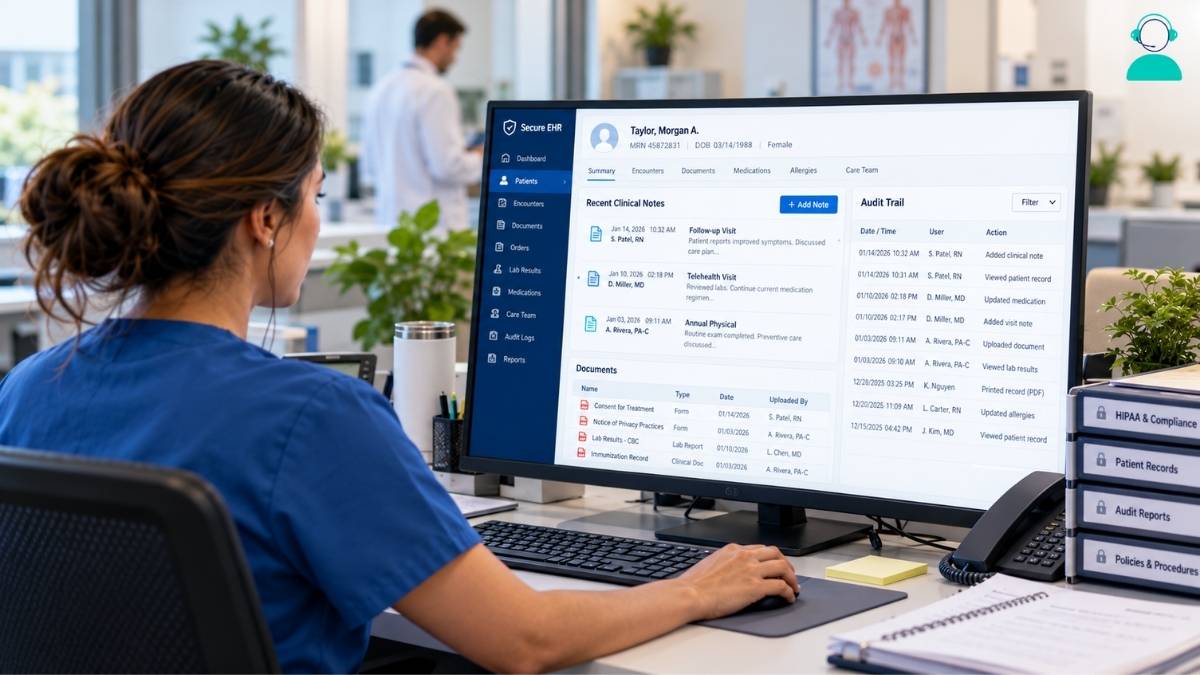
Clear ownership prevents gaps between clinical and administrative work. Clinical judgment stays with the billing practitioner and qualified clinical staff. Administrative staff support records, reminders, and reporting under practice policy.
A healthcare virtual assistant can handle non-clinical support such as organizing charts and preparing monthly reports. Administrative minutes should not count toward clinical management time.
Assistants do not make clinical decisions, and state scope rules set the final limits. Readers who want task-level detail can review how virtual assistants support RPM workflows.
| Task | Responsible | Reviewer |
| Order and medical necessity | Billing practitioner | Billing supervisor |
| Consent collection | Authorized staff | Practice manager |
| Device setup and education | Clinical staff | Billing practitioner |
| Reading logs and day counts | Administrative staff | Billing supervisor |
| Management time and notes | Clinical staff or practitioner | Billing practitioner |
| Month-end code match | Billing supervisor | Practice manager |
Each task has one accountable owner and one independent reviewer.
| Scope note |
|---|
| These rules apply to medical practices billing Medicare. Dental and veterinary practices use different coding systems and payers. |
HIPAA, EHR Records, And Audit Safeguards
RPM generates protected health information daily, so privacy controls matter alongside billing logic. Audit exposure grows when staff, vendors, and systems touch the same chart.
HIPAA generally treats vendors that create, receive, maintain, or transmit PHI for a practice as business associates. A business associate agreement should be in place before access begins.
Remote staff follow the same logic, and these HIPAA-compliant virtual assistant practices cover minimum necessary access and unique logins.
EHR entries need date stamps and user attribution. Corrections belong in dated amendments, which preserves the audit trail.
An OIG review found that about 43 percent of Medicare enrollees receiving RPM missed at least one component. Complete RPM audit documentation for setup, supply, and management answers that concern directly.
A Monthly RPM Billing Workflow
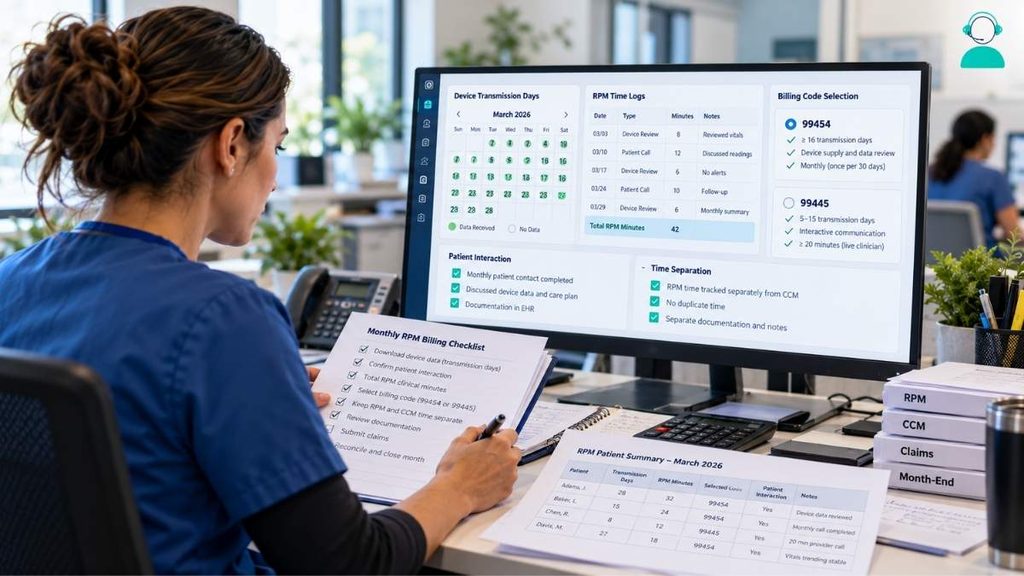
A repeatable close-out prevents the most common month-end errors. The steps below fit most practices and can be adjusted to payer rules.
- Count transmission days and select 99445 or 99454.
- Total clinical minutes and select the management code.
- Confirm that one real-time interaction occurred with the patient.
- Check that consent and the order are on file.
- Remove any minutes already counted toward chronic care management.
CMS allows RPM and chronic care management for the same patient when time and effort are not counted twice. RPM and CCM billing together therefore needs separate time logs. The article on CCM virtual assistants and patient follow-up covers the care management side.
Frequently Asked Questions (FAQs)
What documentation does Medicare require for remote patient monitoring?
Medicare expects proof of an established patient relationship, medical necessity, consent, device setup, transmitted data, and clinical time. Each record must support the specific code billed that month.
Is patient consent required for RPM, and must it be written?
CMS requires consent at the time services are provided. Payers differ on written versus verbal consent, so each policy should be confirmed.
Can CPT 99445 and 99454 be billed in the same period?
No, only one device supply code applies to a patient in a 30-day period. The data-day count decides which code applies that month.
Can a virtual assistant document RPM services?
Administrative support is possible under practice policy and supervision. Clinical decisions and clinical time remain with licensed staff.
Can RPM and chronic care management be billed in the same month?
CMS allows both for the same patient when time and effort are not counted twice. Separate time logs make that easy to prove.
Final Thoughts
Strong remote patient monitoring documentation requirements come down to five records. Eligibility, consent, setup, data days, and clinical time each need dated proof. Assigning an owner to every record reduces gaps between clinical and administrative work.
A quarterly review of sampled charts can catch missing entries before an auditor does. Clear ownership also keeps administrative and clinical duties separate. Rules change with each annual fee schedule update, so MAC and payer policies need regular rechecks.
References
- CMS, Telehealth & Remote Monitoring, MLN901705 (December 2025)
- Noridian JE Part B, Remote Patient Monitoring Documentation Requirements
- HHS OIG, Additional Oversight of Remote Patient Monitoring in Medicare Is Needed (September 2024)