Front-desk phones ring while billing claims sit unprocessed and patient records wait for updates. Many clinics reach a point where staff time no longer covers the daily workload. Adding a full-time employee raises payroll costs, benefits, and training time.
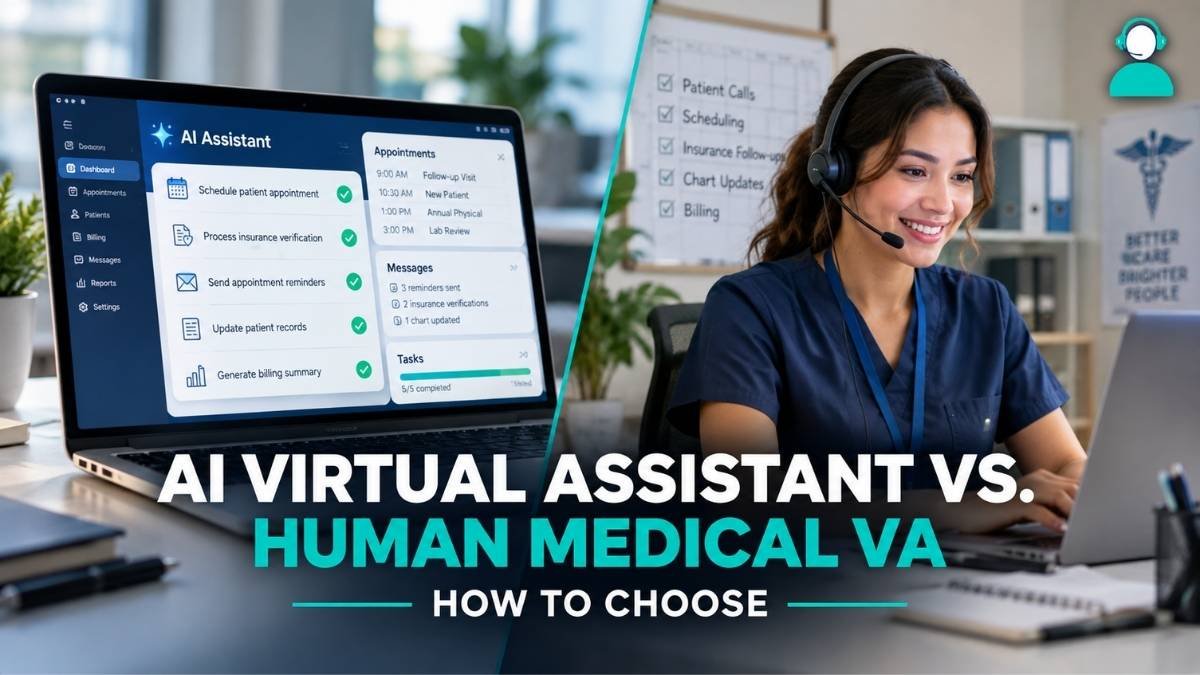
Outsourcing certain functions to a medical virtual assistant offers another path, but the choice is not simple. Clinics must decide between an AI virtual assistant vs. human medical VA, and the two options function differently.
One executes rules-based tasks through software. The other applies judgment to billing exceptions, scheduling conflicts, and patient communication.
Practice managers who understand these distinctions make staffing decisions based on operational need, not marketing claims.
What Is An AI Virtual Assistant In A Medical Setting?

An AI virtual assistant is a type of healthcare virtual assistant built on software that automates repetitive clinic tasks. It relies on programmed rules and pattern recognition rather than independent judgment.
Common examples include appointment reminder systems, automated intake forms, and AI chatbot tools that answer basic patient questions.
Many practices use AI for transcription support, turning provider dictation into draft clinical notes. These tools connect to scheduling software and electronic health records, but they do not replace review.
Machine learning models improve accuracy over time as they process more data. This reflects a broader pattern in AI in healthcare: administrative automation, part of the wider shift toward healthcare automation, tends to arrive before clinical automation.
Still, an AI virtual assistant follows fixed logic. When a request falls outside its programmed scope, it either escalates the task or produces an incorrect response. This is why AI works best for high-volume, low-complexity tasks rather than exception handling.
Also Read: Can Virtual Assistants Help With Medical Transcription?
What Is A Human Medical Virtual Assistant?

A human medical VA is a remote employee trained in billing, scheduling, and documentation support. Unlike automated tools, this person applies judgment to non-standard situations.
Human medical VAs typically handle medical billing, medical coding, EHR data entry, and patient scheduling exceptions. Many also manage patient engagement tasks such as appointment confirmations, insurance verification calls, and follow-up communication.
Because a human reviews each case individually, this model handles complex billing disputes and denial appeals more reliably. Training usually covers practice-specific software, payer requirements, and HIPAA compliance protocols.
Onboarding takes longer than deploying an AI tool, since a person must learn each clinic’s workflow. Once trained, a human VA can flag irregularities that automated systems miss, including coding patterns tied to recurring denials.
AI Virtual Assistant Vs. Human Medical VA – Core Operational Differences

Choosing between an AI virtual assistant vs. human medical VA requires comparing specific operational areas. Each model handles billing, scheduling, documentation, and compliance differently. The following sections break down these differences by function.
| Task Area | AI Virtual Assistant | Human Medical VA |
| Patient Scheduling | Automated booking, reminders | Handles conflicts, cancellations, exceptions |
| Medical Billing | Claim scrubbing, code suggestions | Denial management, payer follow-up |
| Clinical Documentation | Transcription, summarization | Review, validation, EHR data entry |
| Compliance Judgment | Limited to programmed rules | Contextual, HIPAA-aware decision-making |
| Availability | Continuous, automated response | Scheduled coverage with human oversight |
Task Handling and Workflow Coverage
An AI virtual assistant executes single-step or rules-based tasks with consistent speed. It handles appointment confirmations, reminder calls, and basic intake questions without variation.
A human medical VA manages multi-step workflows that shift based on context. Billing follow-up, for example, often requires reading a denial letter, checking payer rules, and deciding on next steps.
Workflow complexity is the main factor separating these two models. Simple, repeatable tasks suit AI. Tasks requiring sequencing judgment, such as coordinating between providers and payers, suit a human VA.
Also Read: Tasks A Medical Virtual Assistant Can Do
Medical Billing and Coding Accuracy
AI tools support medical billing by scrubbing claims and flagging missing modifiers before submission. This catches straightforward errors and speeds up clean-claim rates.
Complex denials still need a trained eye. As one billing and coding expert put it, “sometimes you have to get really creative to get a claim paid.”
Human medical VAs interpret payer-specific rules, appeal denials, and adjust coding based on documentation nuance. AI-assisted coding tools report accuracy below 50 percent in some complex cases without human review.
Pairing automated scrubbing with human verification produces the most reliable results for medical coding accuracy.
Patient Scheduling and Calendar Management
AI handles routine patient scheduling through automated booking links and reminder sequences. It fills open slots quickly and reduces manual phone time for simple bookings.
Complications arise with overbooked calendars, provider-specific rules, or last-minute cancellations. A human medical VA resolves these conflicts by contacting patients directly and adjusting the schedule in real time.
Multi-provider practices with variable scheduling rules often need this level of oversight. AI scheduling tools work well as a first layer, with human staff managing exceptions.
Clinical Documentation and EHR Data Entry
AI transcription tools convert provider dictation into draft clinical documentation quickly. This reduces the time physicians spend typing notes after patient visits.
The draft still requires review before it becomes part of the permanent record. Human medical VAs validate this documentation, correct errors, and enter structured data into electronic health records.
This step matters because inaccurate EHR entries can affect billing codes and patient safety. A combined workflow, AI drafting and human review, produces documentation that meets clinical and coding standards.
Also Read: How Virtual Assistants Improve Medical Record Accuracy?
HIPAA Compliance and Data Security Considerations
Any AI tool that touches protected health information qualifies as a business associate under HIPAA. This requires a signed Business Associate Agreement before the tool processes patient data.
Encryption, access controls, and audit logs must be in place regardless of whether a task is automated or human-handled.
Human medical VAs carry direct accountability for judgment calls involving PHI. This includes deciding what information to share during a call.
| Compliance Tip |
|---|
| A vendor calling a tool “HIPAA-compliant” does not remove the clinic’s obligation to sign a Business Associate Agreement and verify safeguards. Compliance is shaped by contracts and controls, not a label. |
HIPAA Journal reported 772 large healthcare data breaches logged with federal regulators in 2025. Compliance is not a feature a vendor adds later. It has to shape the workflow from the start.
Response Time and Availability
AI virtual assistants operate continuously, responding to patient messages and booking requests at any hour. This suits after-hours scheduling requests and basic FAQ handling well.
Human medical VAs work scheduled hours, typically aligned with the clinic’s business day. Their availability is more limited, but their responses account for context AI may miss.
A late-night scheduling request is simple for AI to process. A billing dispute at 9 a.m. usually needs a person who can review the account history first.
Cost Structure and Staffing Investment
AI virtual assistant tools typically run on monthly software subscriptions tied to usage volume. Costs scale predictably as call or message volume grows.
A human medical VA usually involves hourly or salaried compensation, plus training time. This model costs more per hour but includes judgment-based problem-solving as part of the role.
Rihan Javid, D.O., J.D., described the staffing reality at a recent MGMA conference. He said many practices settle for “one or two people, when you need three.”
Clinics comparing options should compare task volume against task complexity, not price alone.
Also Read: How Virtual Assistants Help Clinics During Staffing Shortages?
Implementation and Onboarding Requirements
Deploying an AI virtual assistant requires system integration with scheduling software and EHR platforms. Setup can take days to weeks depending on the complexity of existing systems.
A human medical VA requires onboarding into clinic-specific workflows, payer relationships, and communication style. This process typically takes longer, often several weeks of supervised work.
Neither option delivers full value on day one. Clinics should budget implementation time into their planning, not just monthly cost.
Which Tasks Are Safe To Delegate To AI Vs. A Human VA?
Not every task carries the same risk if handled incorrectly. Some administrative work tolerates automation well, while other tasks require judgment and accountability. This section separates tasks by risk level.
Lower-risk tasks suit AI virtual assistants because errors are easy to catch and correct:
- Appointment reminders and confirmations
- Basic patient intake forms
- FAQ responses about hours, location, or general policies
- Telehealth appointment confirmations and pre-visit reminders
Higher-risk tasks benefit from human medical VA involvement because mistakes carry financial or compliance consequences:
- Denial management and payer appeals
- Complex scheduling involving multiple providers or insurance authorizations
- Patient communication about billing disputes or account balances
- Entering or correcting data in electronic health records
This distinction is not permanent. As AI tools mature, some tasks may shift categories. For now, matching task risk to the right model reduces errors and protects revenue.
How To Decide Between An AI Virtual Assistant And A Human Medical VA
Clinic leaders can evaluate several factors before choosing a model. Task volume, complexity, budget, and compliance risk all play a role. Most practices benefit from combining both approaches rather than choosing only one.
Practice size affects the decision directly. Small practices with low patient volume may find AI sufficient for scheduling and reminders.
Larger practices with multiple providers usually need a human medical VA for billing exceptions and calendar coordination. Budget also plays a role, since AI subscriptions cost less per interaction but cannot handle every scenario.
Compliance risk tolerance matters too. Practices handling complex payer contracts or behavioral health billing benefit from human oversight on judgment-heavy tasks.
| Operational Note |
|---|
| A hybrid model, AI for volume and a human medical VA for exceptions, is now common across medical practice management teams rather than an either-or choice. |
Many clinics now combine both models, using AI for routine volume and human staff for exceptions and oversight.
Common Mistakes Clinics Make When Choosing A Virtual Assistant Model

Clinics often default to one model without evaluating actual task needs. This leads to gaps in coverage or unnecessary spending. The mistakes below appear frequently across medical, dental, and veterinary practices.
A common mistake is assuming AI eliminates all staffing costs. AI reduces certain workloads but does not remove the need for oversight on complex tasks.
Another mistake involves assigning judgment-heavy billing work, such as denial appeals, to automated tools without human review. This increases the risk of denied or underpaid claims.
| Common Billing Mistake |
|---|
| Routing complex denial appeals through AI alone, without a trained reviewer, increases claim rejection rates and delays reimbursement. |
A third mistake is underestimating HIPAA compliance requirements for AI tools. Any system handling patient data needs a signed Business Associate Agreement and documented security safeguards, regardless of whether it is software or staff.
Skipping this step creates compliance exposure that surfaces during an audit, not before.
Frequently Asked Questions (FAQs)
What tasks can an AI virtual assistant handle safely in a medical practice?
AI handles repetitive, rules-based tasks well, including appointment reminders, basic intake forms, and routine scheduling. These tasks involve low risk if an error occurs. Complex billing disputes and clinical judgment calls still require human review.
Is a human medical VA required for HIPAA-compliant billing work?
A human medical VA is not strictly required, but HIPAA compliance applies regardless of who or what handles the data. Any AI tool processing patient information needs a signed Business Associate Agreement and documented safeguards. Human oversight often reduces compliance risk on judgment-heavy tasks.
Can AI and human virtual assistants work together in the same practice?
Yes, many practices combine both. AI manages high-volume, repetitive tasks such as reminders and intake forms. A human medical VA handles billing exceptions, complex scheduling, and compliance-sensitive communication.
How much does a human medical VA cost compared to AI software?
Costs vary by task volume and scope of work. AI tools typically run on monthly subscriptions tied to usage, while a human medical VA involves hourly or salaried pay. Clinics should compare cost against task complexity, not price alone.
Final Thoughts
Choosing between an AI virtual assistant vs. human medical VA depends on task complexity, compliance risk, and staffing budget.
AI tools handle repetitive, rules-based work efficiently. Human medical VAs manage judgment-driven billing, documentation, and patient communication tasks.
Most practices benefit from combining both models, automating routine workflows while keeping trained staff accountable for compliance-sensitive decisions.
Clinic leaders should map their own task volume and risk tolerance before selecting a staffing model, rather than defaulting to one option.
References
- American Medical Association. “AMA: Physicians Enthusiastic but Cautious About Health Care AI.” https://www.ama-assn.org/press-center/press-releases/ama-physicians-enthusiastic-cautious-about-health-care-ai
- American Medical Association. “2 in 3 Physicians Are Using Health AI—Up 78% From 2023.” https://ama-assn.org/practice-management/digital/2-3-physicians-are-using-health-ai-78-2023
- Medical Economics. “Fixing Administrative Shortages: A Conversation With Rihan Javid, D.O., J.D.” https://www.medicaleconomics.com/view/fixing-administrative-shortages-a-conversation-with-rihan-javid-d-o-j-d-
- Outsource Strategies International. “The Importance of Human Expertise in Medical Billing.” https://www.outsourcestrategies.com/blog/importance-human-expertise-medical-billing/
- Open.cx. “HIPAA-Compliant AI Chatbots for Patient Support: A Checklist.” https://www.open.cx/blog/hipaa-compliant-ai-chatbot-for-patient-support
- Vasundhara. “HIPAA-Compliant AI Chatbots in Healthcare.” https://www.vasundhara.io/blogs/hipaa-compliant-ai-chatbots-healthcare