

Veterinary practices face steady growth in patient volume and administrative complexity. Appointment coordination, billing accuracy, and documentation standards require consistent oversight. These pressures affect daily operations and long-term staffing decisions.
Clinic owners and managers must evaluate how to maintain efficiency without expanding payroll unnecessarily. Many leaders now examine why veterinary practices should hire virtual assistants instead of adding in-house roles. This evaluation requires clear analysis of workflow distribution and cost structure.
An operational decision must rely on data rather than trends. Administrative tasks accumulate gradually across scheduling, communication, and reporting functions. Understanding where strain originates helps leadership choose an appropriate staffing model.
The Administrative Strain In Modern Veterinary Practices
Administrative responsibilities in veterinary clinics extend well beyond basic reception work. Staff manage phone calls, digital messages, insurance verification, and electronic record updates simultaneously. These overlapping duties compete for attention throughout the day.
When demand increases, technicians often assist with calls and paperwork. Veterinarians may complete documentation after clinic hours to maintain accuracy. Clinical productivity declines when licensed professionals handle repetitive administrative tasks.
Overtime expenses rise when administrative volume exceeds available support capacity. Documentation delays and billing backlogs become more frequent under sustained strain. Structural imbalance, rather than poor management, usually drives these outcomes.
What Tasks Can Veterinary Virtual Assistants Handle?

Clear role definition determines whether remote support improves or disrupts operations. Virtual veterinary assistants function best when clinics assign structured, non-clinical tasks with documented procedures. Leadership must define scope before delegation begins.
Administrative redistribution does not replace in-house staff. It reallocates repetitive responsibilities to protect clinical capacity. The following task areas reflect common delegation models in veterinary practices.
1. Scheduling and Calendar Coordination
Appointment management requires constant monitoring of calendars and booking channels. A veterinary virtual assistant can confirm visits, process rescheduling requests, and send reminders through existing systems. This structure supports veterinary appointment scheduling support without altering provider control.
Clinic leadership retains authority over visit types and scheduling templates. The assistant follows predefined rules inside the practice management platform. This approach reduces call congestion and protects front desk stability.
2. Client Communication Support
Front desk teams manage large volumes of non-clinical emails and portal messages daily. A virtual vet assistant can respond to policy questions and route medical inquiries appropriately. This separation reduces interruptions during in-person check-ins.
Licensed personnel continue handling clinical advice and urgent concerns. Escalation pathways must remain clearly documented and enforced. Administrative message management improves response consistency without compromising patient safety.
3. Documentation and Record Support
Accurate records support billing accuracy and regulatory compliance. A virtual assistant can organize templates and reconcile data fields within electronic systems. This work provides veterinary medical record documentation support under internal guidelines.
Clinical assessments and treatment plans remain the responsibility of veterinarians. The assistant does not create medical opinions or diagnoses. Structured documentation support improves completeness and reduces after-hours charting.
4. Billing and Insurance Coordination
Revenue cycle performance depends on timely claim submission and follow-up. A virtual veterinary assistant can track claims and assist with veterinary billing and insurance verification processes. This support improves visibility into outstanding balances.
Final review authority remains within the clinic. Leadership monitors denial patterns and payment timelines directly. Administrative assistance reduces delays without reducing financial oversight.
5. Prescription Refill Processing
Prescription refill requests arrive through phone calls, emails, and pharmacy portals. A virtual assistant can log requests and verify required documentation before routing approvals. This workflow limits exam room interruptions.
Veterinarians maintain final authorization for every prescription. Documentation trails remain inside the electronic record system. Structured processing improves efficiency while preserving compliance standards.
6. Reporting and Data Entry
Practice managers rely on accurate operational reports for planning decisions. A virtual assistant can compile daily production summaries and update performance dashboards. These tasks support practice management workflow optimization efforts.
Leadership interprets trends and sets strategy independently. The assistant handles repetitive data extraction and entry tasks. Clear report parameters ensure accuracy and accountability.
7. Referral and Lab Coordination
Referral transmission and laboratory tracking require organized communication. A veterinary virtual assistant can send records and confirm receipt with specialty clinics. The assistant can also monitor pending laboratory results.
Clinical interpretation remains the responsibility of veterinarians. Administrative coordination ensures that no report remains untracked. Structured oversight reduces follow-up delays and missed callbacks.
8. After-Hours Administrative Support
Voicemail and online inquiries accumulate outside regular clinic hours. A virtual assistant can categorize messages and prepare callback summaries for morning review. This process reduces early-day congestion.
Emergency protocols remain unchanged under this model. Urgent clinical decisions stay with licensed staff members. Administrative sorting improves workflow efficiency at the start of each day.
Operational Benefits Without Expanding In-House Staff
Clinic staffing decisions directly influence payroll stability and workflow sustainability. Many practices evaluate whether administrative workload justifies hiring permanent employees. Remote administrative support offers an alternative model for managing operational demand.
Here are the most common benefits of having a remote assistant:
Cost Structure Considerations
Traditional hiring models rely on fixed salary commitments regardless of workload volume. Service-based remote support models allow clinics to align expenses with actual administrative demand. This difference becomes significant for small and mid-sized practices managing variable patient flow.
Equipment and workspace overhead also contribute to employment costs. In-house staff require dedicated computers, office space, and system maintenance. Remote assistants operate within their own infrastructure while accessing authorized clinic systems.
Leadership should evaluate total operational cost rather than hourly wage comparisons alone. Long-term administrative efficiency depends on balancing workload distribution with financial sustainability.
Staffing Flexibility
Administrative demand rarely remains constant throughout the year. Clinics may need additional support during vaccination drives, holiday scheduling periods, or unexpected staff absences. Remote assistants allow scaling working hours up or down according to demand.
Maternity leave coverage and employee turnover create operational risk in traditional staffing models. Recruitment and training cycles require time and resources. Virtual assistance can provide continuity during these transition periods.
Flexible staffing also supports short-term workflow projects. Practices can allocate temporary administrative resources without committing to permanent employment contracts.
Burnout Reduction
Administrative workload often falls on technicians and veterinarians when front desk capacity becomes limited. Repetitive tasks such as call handling and documentation formatting reduce time available for patient care.
Removing non-clinical burden helps clinicians focus on medical decision-making and treatment procedures. Staff retention may improve when administrative pressure decreases across clinical roles.
Burnout reduction is not only a human resource concern. It also supports patient safety and operational reliability. Sustainable workflow distribution contributes to long-term practice stability.
Compliance, Security, and Workflow Integration

Healthcare administrative outsourcing must operate inside strict governance boundaries. Clinics are responsible for protecting patient information regardless of whether work is performed on-site or remotely. Structured control systems reduce operational and legal risk.
Data Security and Confidentiality
Patient information protection remains the primary concern when using remote administrative services. HIPAA-related standards should guide access design where applicable. Clinics must confirm that service providers follow recognized healthcare data protection protocols.
Secure access protocols limit login entry to authorized systems only. Multi-factor authentication and encrypted communication channels reduce unauthorized access risk. Role-based permissions ensure assistants view only necessary information for assigned tasks.
Remote staff should not store clinical data outside approved systems. File sharing should occur through controlled clinic platforms. Documentation of security compliance strengthens internal audit readiness and risk management oversight.
Practice Management Software Integration
Remote workflow success depends on compatibility with existing practice management platforms. Clinics should verify that virtual assistants can operate within approved remote login systems. Technical testing should occur before full deployment.
Electronic health record (EHR) workflow alignment prevents data duplication and entry errors. Administrative tasks must follow the same sequence used by in-house staff. Consistency reduces training complexity and operational confusion.
System access should be monitored periodically. Leadership should review login activity logs and performance metrics. Proper integration ensures remote support enhances workflow efficiency without introducing technical instability.
SOP Development
Standard operating procedures provide the foundation of controlled delegation. Clinics must document every administrative workflow assigned to remote assistants. Task instructions should include step-by-step execution guidelines.
Escalation processes must clearly define when clinical staff intervention is required. Communication channels between in-house and remote teams should remain consistent. Email, secure messaging, or internal task management tools are commonly used.
Without SOPs, remote assistance can create operational ambiguity. Structured delegation preserves accountability and reduces service variability. Written protocols also help maintain compliance during audits or regulatory reviews.
Quality Control Measures
Performance tracking systems allow clinics to monitor administrative output quality. Key metrics may include response time, documentation accuracy, and task completion rates. Regular reporting supports management oversight.
Error review processes should exist for claim submissions, scheduling changes, and record updates. Identified mistakes must be corrected through documented correction workflows. Continuous quality monitoring improves service reliability.
Audit readiness requires organized documentation of access permissions, task assignments, and communication records. Internal controls protect the clinic during regulatory inspections. Risk management depends on consistent monitoring rather than occasional review.
How To Evaluate If A Virtual Assistant Is Right For Your Practice
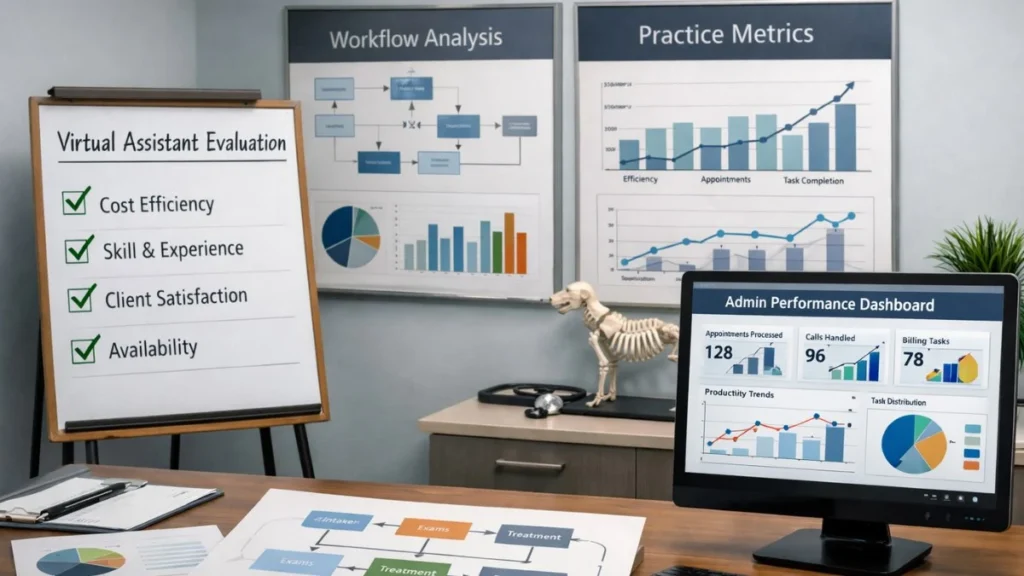
The decision to use remote administrative support should begin with internal workflow analysis. Clinics must understand where time resources are currently consumed. Evaluation should focus on measurable operational indicators rather than assumptions.
Leadership should analyze daily task distribution across staff members. Administrative delegation works best when supported by objective workload data. Structured assessment prevents inefficient outsourcing decisions.
Identify Repetitive Administrative Tasks
Conduct a time audit covering at least one standard operational week. Record activities that occur repeatedly during clinic operations. Categorize tasks into clinical and non-clinical functions.
Clinical tasks must remain under licensed supervision. Non-clinical workflows such as scheduling or reporting are often suitable for remote delegation. Proper categorization reduces compliance risk.
Measure Administrative Bottlenecks
Monitor call abandonment rates and delayed message responses. Documentation backlog frequency also reflects workflow congestion. These metrics help identify where administrative capacity is insufficient.
Bottlenecks often occur during morning opening hours and afternoon discharge periods. Addressing these periods improves patient flow stability. Data-driven evaluation supports responsible staffing decisions.
Define Internal Workflow Boundaries
Determine which responsibilities must remain physically or operationally inside the clinic. Medical triage, clinical decision-making, and emergency response coordination should remain on-site.
Administrative tasks that follow predefined rules may be delegated securely. Examples include appointment confirmation, data entry, and reporting preparation. Boundary definition protects both compliance and operational clarity.
Start With A Limited Scope
Implementation should begin with a pilot workflow rather than full administrative transition. Select one department or task category for initial testing. Early evaluation helps leadership assess performance quality.
Trial periods reduce operational risk and allow performance benchmarking. Clinics can adjust SOPs and communication channels before scaling support. Practical adoption improves long-term success probability.
Final Thoughts
Admin workload continues to grow alongside clinical service demand in veterinary practices. Understanding workflow structure is essential when evaluating why veterinary practices should hire virtual assistants. Remote administrative support offers flexibility, cost predictability, and scalability when applied to appropriate tasks.
The most effective strategy is not replacing in-house teams but optimizing task distribution. Clinics should evaluate workload patterns, compliance requirements, and operational boundaries before implementation. Structured delegation supports efficiency while maintaining clinical oversight and patient safety.