

Documentation pressure often peaks during clinic hours as providers move between patients while notes remain incomplete in the EHR system. Administrative staff manage intake, scheduling, and billing simultaneously, leaving little capacity for transcription and slowing flow.
In many clinics, transcription is not a defined workflow. It overlaps with other tasks, leading to delays in clinical documentation workflows and incomplete records that carry into coding and claims.
This raises a practical question: can virtual assistants help with medical transcription without affecting accuracy or compliance? The answer depends on how clearly transcription tasks and processes are structured before delegation. Let’s discuss this in details!
Can Virtual Assistants Help With Medical Transcription?

Virtual assistants can support medical transcription when their role is clearly defined within the documentation workflow. They convert provider dictation into structured clinical notes, review transcripts, and update records in the EHR system. Their work remains operational and does not involve clinical interpretation.
Medical transcription now extends beyond typing audio. It includes editing speech-to-text outputs, aligning notes with billing requirements, and maintaining consistent structure. Healthcare virtual assistants function as an execution layer that ensures documentation is complete and properly formatted before review.
A common question is whether remote transcription affects accuracy. The outcome depends on process design. With templates, review checkpoints, and provider validation in place, transcription tasks can be handled remotely while maintaining documentation quality and compliance.
What “Medical Transcription” Includes In Today’s Clinic Environment
Medical transcription has expanded into a broader documentation function that connects directly to clinical documentation workflows. It supports how information moves from provider input to structured records that are usable for coding, compliance, and patient care continuity.
Dictation, Voice Notes, and Speech-to-Text Outputs
Providers rely on dictation to capture encounter details efficiently. These inputs may come as recorded audio or speech recognition outputs, both of which require processing before they become structured documentation. The raw input often lacks clarity or formatting.
Speech-to-text tools improve speed but not accuracy. Errors in terminology or sentence structure are common, which makes review essential. Virtual assistants typically handle this stage, ensuring that the documentation aligns with clinical standards before it moves forward.
Clinical Documentation Types That Require Transcription
Clinical documentation includes multiple formats that depend on transcription. These range from SOAP notes and progress notes to operative reports and discharge summaries, each with its own structure and compliance requirements. Consistency across these formats is essential.
Dental and veterinary clinics follow similar documentation patterns, although terminology differs. This variation adds complexity to transcription workflows. Support must adapt to these differences while maintaining accuracy and structure.
Where Transcription Fits In The Documentation Workflow
Transcription sits between the patient encounter and final record completion. Providers generate notes, but those notes must be processed and structured before they are usable for billing or future care decisions. This stage is often overlooked in workflow planning.
When transcription is delayed, the impact spreads across operations. Claims submission slows down, and incomplete records begin to accumulate. Clinics usually notice this pattern only after backlogs become consistent rather than occasional.
What Virtual Assistants Can Do In Medical Transcription
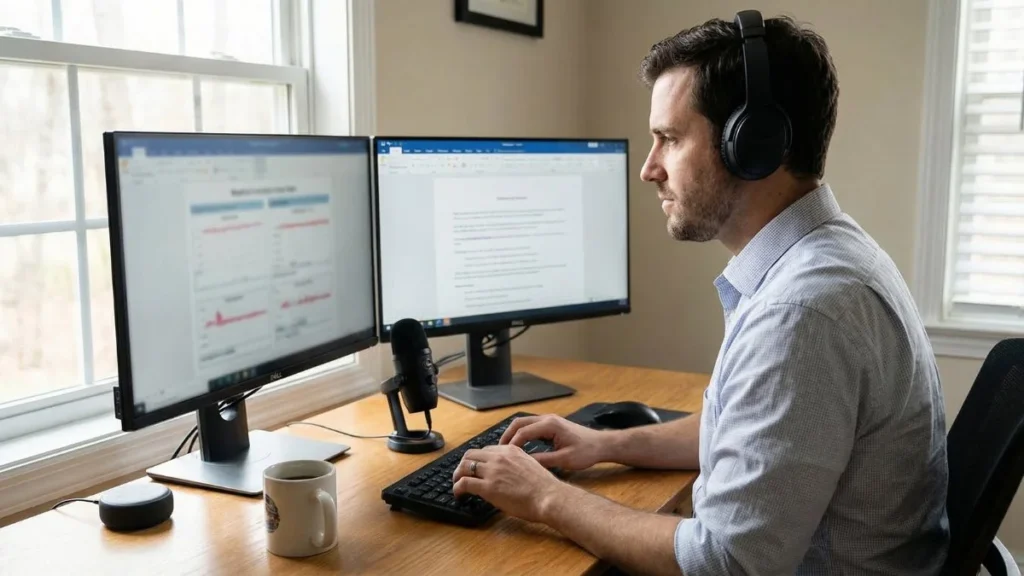
Virtual assistants contribute effectively when their role is limited to execution within defined boundaries. Their work supports documentation flow, but it does not replace clinical responsibility. This distinction is important for maintaining both accuracy and compliance.
Tasks Virtual Assistants Can Perform Reliably
Virtual assistants can transcribe dictated audio into structured clinical notes. They follow predefined templates and provider-specific formats, which helps maintain consistency across records. This includes organizing information into recognized documentation structures.
They also edit transcripts to improve clarity and completeness. Errors in grammar or terminology are corrected during this step, which ensures the documentation is ready for coding and review without additional rework.
EHR Data Entry and Documentation Updates
Virtual assistants can enter transcribed notes directly into the EHR system. They update patient charts and ensure that information is placed in the correct sections, which supports continuity across visits. Accuracy in placement is as important as accuracy in content.
Incomplete or misplaced data can affect both clinical understanding and billing outcomes. For this reason, transcription support must be aligned with EHR workflows rather than treated as a separate task.
Documentation Formatting and Standardization
Standardization plays a key role in documentation quality. Virtual assistants apply templates such as SOAP formats or clinic-specific structures, which reduces variation between providers. This creates more predictable records.
Consistent formatting also supports coding teams. It simplifies review processes and improves alignment with billing requirements. Over time, standardized documentation reduces errors and improves efficiency.
Proofreading and Error Correction In Medical Records
Initial transcription often contains small errors. These may include unclear phrasing, missing details, or incorrect terminology. Virtual assistants review notes to correct these issues before finalization.
They also identify sections that require clarification. Instead of making assumptions, they flag these areas for provider input. This approach maintains accuracy without crossing into clinical interpretation.
Also Read: Tasks A Medical Virtual Assistant Can Do
What Virtual Assistants Typically Do Not Handle
Virtual assistants do not interpret clinical information. They do not assign diagnoses, evaluate symptoms, or finalize coding decisions. These responsibilities remain with licensed professionals at all times.
This boundary ensures compliance with healthcare regulations. It also reduces operational risk by keeping clinical judgment within the appropriate scope.
Handling Specialty-Specific Transcription Requirements
Different specialties require different documentation approaches. Dental, veterinary, and medical practices all use distinct terminology and formats, which increases transcription complexity. This variation must be addressed carefully.
Virtual assistants trained in specific specialties can adapt more effectively. Familiarity with terminology improves both accuracy and processing speed. This reduces the need for repeated corrections.
Managing Transcription Turnaround and Work Queues
Transcription workflows depend on prioritization. Virtual assistants manage documentation queues to ensure that urgent notes are completed first, especially those linked to billing or follow-up care. This helps maintain operational flow.
Routine documentation is processed in sequence after priority tasks. This structured approach reduces backlog and supports consistent turnaround times across the clinic.
Working Alongside AI Transcription Tools
Speech recognition tools generate transcripts quickly, but they are not fully reliable. Errors in terminology, formatting, and context are common. Human review remains necessary for accuracy.
Virtual assistants refine these outputs before they are entered into the record. This combination of automation and manual review improves both efficiency and documentation quality.
Accuracy, Quality, and Compliance In Virtual Medical Transcription
Accuracy and compliance are not optional elements in transcription workflows. They determine whether documentation can be trusted for billing, legal, and clinical purposes. Remote support must meet the same standards as in-house processes.
How Accuracy Is Maintained In Remotely
Accuracy depends on structured processes and clear documentation standards. Virtual assistants follow predefined templates and guidelines, which reduces variation across records. This creates consistency.
Providers may review final notes when necessary. This adds a validation layer that ensures documentation remains clinically accurate and aligned with care decisions.
HIPAA-Compliant Transcription Processes
Handling patient data requires strict adherence to HIPAA compliance standards. Virtual assistants must operate within secure systems that control access to sensitive information. Data protection remains central to transcription workflows.
Encryption and role-based permissions limit exposure. Clinics must ensure that these controls are consistently applied. Responsibility for compliance remains with the organization.
Common Documentation Errors and Management
Errors often originate from unclear dictation or incomplete input. These issues can affect coding accuracy and patient records if not addressed early. Identification is the first step.
Virtual assistants flag inconsistencies and request clarification. Over time, this feedback improves dictation quality and reduces repeated errors within the workflow.
Training Requirements For Medical Transcription Support
Effective transcription requires familiarity with medical terminology and documentation structures. Virtual assistants must understand both the language and the workflow. This ensures accuracy in execution.
Training should reflect clinic-specific requirements. Ongoing updates help maintain consistency, especially in specialties where terminology evolves or varies.
Operational Benefits of Using Virtual Assistants For Medical Transcription

Operational benefits become visible when transcription workflows are clearly structured. Virtual assistants do not change clinical processes, but they improve how documentation moves through the system. This affects both efficiency and workload distribution.
- Reduced provider documentation time
Providers spend less time completing notes after clinic hours. This supports better use of clinical time and reduces delays in documentation completion.
- Improved documentation turnaround time
Notes are processed more consistently, which reduces backlog. Faster completion supports billing timelines and improves record availability.
- Lower administrative workload for in-house staff
Administrative teams can focus on scheduling and patient communication. Transcription tasks are handled separately, which improves overall efficiency.
- Consistent formatting and structured documentation
Virtual assistants apply standardized templates, which improves readability and supports coding accuracy. Documentation becomes more uniform across providers.
- Flexible support based on documentation volume
Clinics can adjust transcription support based on patient load. This allows better resource allocation without long-term staffing commitments.
These outcomes depend on implementation rather than the model itself. Clinics that define clear processes and monitor performance see more consistent improvements in documentation workflows.
Virtual Assistants Vs. In-House Medical Transcription – Key Differences
Choosing between in-house and remote transcription depends on how a clinic manages workload, cost, and scalability. Each approach has advantages, but the decision should be based on operational priorities rather than preference.
Cost Structure and Staffing Considerations
In-house transcription involves fixed costs such as salaries and benefits. These costs remain constant regardless of workload, which can create inefficiencies during lower-volume periods.
Virtual transcription support offers a variable cost structure. Clinics can adjust resources based on documentation needs, which provides more flexibility in staffing decisions.
Turnaround Time and Availability
In-house staff typically work fixed schedules, which can delay documentation outside those hours. This often results in accumulated backlog over time.
Virtual assistants can provide extended coverage. Documentation can continue to be processed beyond clinic hours, which improves turnaround consistency.
Workflow Control and Supervision
In-house teams allow direct supervision and immediate communication. This simplifies coordination but requires active management.
Virtual workflows rely on defined processes and communication channels. Clear expectations ensure consistency without requiring constant oversight.
Scalability For Growing Clinics
As patient volume increases, documentation demands also grow. Hiring additional staff takes time, which can delay workflow adjustments.
Virtual assistants allow clinics to scale transcription support more quickly. This helps maintain efficiency during periods of growth without disrupting operations.
How Clinics Implement Virtual Assistants For Medical Transcription
Implementation requires alignment between transcription tasks and existing workflows. Clinics must define responsibilities, standards, and review processes before introducing remote support. This ensures continuity.
Identifying Transcription Tasks To Delegate
Not all documentation tasks should be delegated. Clinics should focus on routine transcription activities that follow predictable patterns.
This approach reduces operational risk. Providers retain control over complex or sensitive documentation tasks.
Setting Documentation Standards and Templates
Clear standards guide transcription accuracy. Templates such as SOAP notes provide structure and consistency across records.
Standardization simplifies both transcription and review. It also supports coding and billing processes more effectively.
Integrating With EHR and Documentation Systems
Virtual assistants require controlled access to EHR systems. Integration must ensure compatibility and maintain data security.
Access should be limited to necessary functions. This protects patient information while supporting workflow efficiency.
Monitoring Transcription Performance and Accuracy
Performance tracking ensures consistent documentation quality. Clinics should monitor turnaround time, error rates, and revision frequency.
Regular review helps identify workflow gaps. Adjustments can then be made to improve both efficiency and accuracy.
Final Thoughts
Virtual assistants can support medical transcription when workflows are clearly defined and compliance standards are maintained. Their role remains focused on documentation execution, which allows clinics to redistribute workload without affecting clinical responsibilities.
The decision to adopt transcription support should be based on operational needs. Clinics that evaluate documentation gaps carefully can determine whether virtual assistance improves efficiency while maintaining accuracy and compliance.